
An ai checker promises a simple answer to a very modern question: was this text written by a person or by a machine? You paste in an essay, a blog post or a cover letter, press a button, and a percentage appears. The trouble is that the number looks far more certain than it really is. Independent research, regulator action and the vendors’ own fine print all point to the same conclusion: an ai checker can be a helpful signal, but it is never proof.
At AI Power Digest, we cover the technology and business stories behind the tools people use every day, and AI detection is one of the most misunderstood. This guide explains what an ai checker actually measures, why accuracy claims vary so widely, who gets hurt by false positives, what Google says about AI-assisted content and how to build a sensible workflow around these tools. Because decisions about grades, jobs and publishing can have real consequences, nothing here is legal, academic or professional advice, and you should always apply your own judgment.
The AI Checker at a Glance
Here is the short version of what the evidence shows as of November 2026:
- What it is: An ai checker, also called an AI detector or AI content detector, analyzes text and returns a probability score estimating whether an AI model produced it.
- What it is not: It is not a lie detector, a plagiarism database or a certificate of authorship.
- Accuracy: Vendor claims often sound near-perfect, while independent tests report much lower and more variable results.
- Biggest risk: False positives, meaning real human writing flagged as AI, especially writing by non-native English speakers.
- Regulatory signal: The U.S. Federal Trade Commission has acted against a detector maker for unsupported accuracy claims.
- Google’s position: Google rewards helpful content however it is made, and we found no Google rule requiring pages to pass an ai checker.
If you take away only one idea, make it this: treat every ai checker score as a lead for human review, not a verdict.
What Is an AI Checker?
An ai checker is software that estimates whether a passage was generated by a language model. One 2026 buyer’s guide describes it as a tool that assigns a probability score indicating how likely it is that writing came from an AI model rather than a person. Different brands use different names, but the core function is the same: look at the patterns in the words and produce a likelihood.
AI Checker Versus Plagiarism Checker
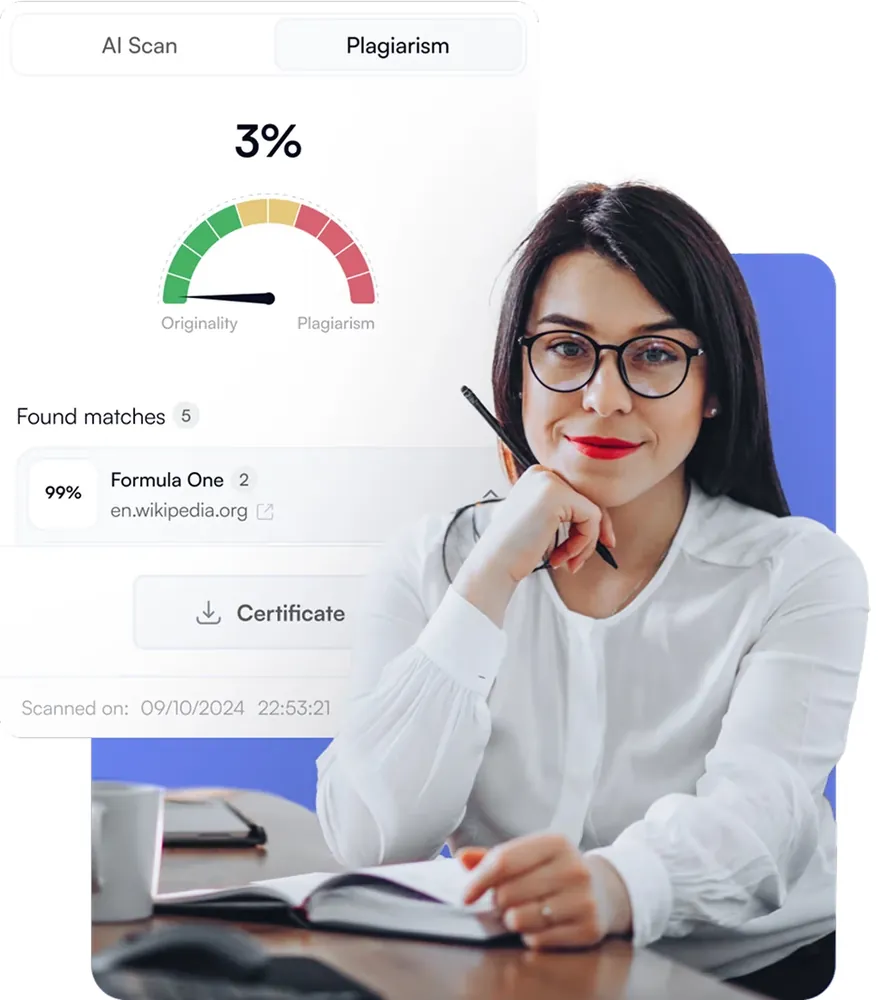
People often confuse these two tools, and some products bundle both. A plagiarism checker compares your text against existing published sources and flags matches. That is a more deterministic task: either the passage appears elsewhere or it does not. An ai checker, by contrast, has nothing to match against. It guesses about the style and statistical texture of the writing.
One 2026 retest of several detectors made this distinction clear. The reviewers found that a bundled plagiarism checker was the most reliable part of a product suite, while the detector component performed far worse. The lesson is that a good plagiarism result tells you nothing about the quality of the detector sitting next to it.
What an AI Checker Score Actually Means
A typical ai checker returns something like “72% AI.” Many readers interpret that as “72% of the text was written by AI.” Usually, it does not mean that. In most tools, the figure is closer to a confidence level about the whole document, and it is calibrated by the vendor’s own model.
Originality.ai, a commercial detector, makes this point in its own explanation of false positives. The company notes that a result of 60 percent original and 40 percent AI is not a false positive, because it correctly expressed 60 percent confidence that the text was original. In other words, even the vendor warns that scores are probabilities, not statements about how many sentences came from a machine.
How an AI Checker Works Behind the Scenes
You do not need a computer science degree to understand the basics. Most detectors rely on a combination of the following ideas.
Predictability and Perplexity
Language models generate text by predicting the next word. Text produced that way tends to be statistically predictable. Many detectors measure this using a metric called perplexity, which captures how surprised a language model is by each word choice. Low perplexity suggests highly predictable writing, which a detector may interpret as machine-made.
Stanford researchers explained the approach in plain terms: detectors typically score based on perplexity, which correlates with the sophistication of the writing. That is a neat shortcut, but it creates a problem. Plenty of human writing is simple, formulaic or constrained, and plenty of machine writing can be nudged toward more complex language with a simple instruction.
Trained Classifiers
Other detectors train a classification model on large collections of human and AI text. The model learns to recognize patterns that separate the two groups. Its performance depends heavily on the examples it was trained on. A model trained mostly on academic writing may do well on essays and poorly on blog posts, marketing copy or technical documentation. As we explain below, that exact problem was at the heart of a U.S. regulatory case.
Watermarking and Why It Is Not a Cure
A separate idea is watermarking, in which a generator embeds subtle statistical signals into its output so that a detector can later identify it. This is appealing in theory, but one 2026 review noted that watermarking proposals remain fragile under paraphrasing and translation. If someone rewrites the text, the signal can weaken or disappear. So a detector built around watermarks would still struggle with edited content, and it could only work for models that actually embed the marks.
How Accurate Is an AI Checker in 2026?
This is the question everyone asks, and the honest answer is that it depends on the tool, the text, the language, the length and the date.
Vendor Claims Versus Independent Tests
Marketing pages tend to feature impressive numbers. Different tools advertise accuracy figures in the high 90s, and some claim figures above 99 percent. Independent testing paints a more varied picture:
- A 2024 test program summarized by one review site found its best premium detector at 84 percent overall accuracy, with several others between roughly 64 and 78 percent.
- A July 2026 retest of three widely used detectors found that all three had lost accuracy compared with earlier testing, and that the newest models were more likely to pass as human.
- That same retest reported that one detector scored around 59 to 61 percent, well below the figure it advertises.
- One benchmark roundup reported that a major academic detector deliberately lets some AI text through, about 15 percent according to its summary of a company statement, in order to reduce false accusations.
We should be careful with these figures. They come from third-party reviewers, some with commercial interests, using different samples and methods, so they are not directly comparable. But the overall pattern is consistent: published accuracy numbers depend on the test, and the real-world experience is often worse than the headline.
Why Accuracy Keeps Changing
Detection is an arms race. Every time a new language model ships, detectors need to catch up. One review observed that any single detector can lag behind new releases by weeks. Another noted that accuracy shifts every time a tool retrains and every time a new model appears. For anyone relying on one of these tools, this means a result that was reliable last spring may be less reliable today.
Length and Formatting Matter
Short samples are harder to classify. Originality.ai itself recommends checking at least 100 words, and says unusual formatting can raise both false positives and false negatives. If you paste a short paragraph, a list of bullet points or a heavily formatted document into a detector, you should expect noisier results.
The False Positive Problem: When an AI Checker Flags Human Writing
If there is one reason to approach an ai checker with caution, it is false positives. A false positive means a detector labels genuine human writing as AI-generated. The consequences can be serious, from a failing grade to a damaged professional reputation.
What the Stanford Study Found
The most cited evidence comes from a Stanford-led study published in the journal Patterns, summarized by Stanford HAI. Researchers tested seven widely used detectors on two sets of essays: 88 written by U.S. eighth-graders and 91 TOEFL essays written by non-native English speakers.
The results were stark:
- The detectors were near-perfect on the essays by U.S.-born students.
- They classified more than half of the TOEFL essays, 61.22 percent on average, as AI-generated.
- All seven detectors agreed in labeling 18 of the 91 TOEFL essays as AI, and at least one flagged 89 of 91, or 97 percent.
The study also found that the detectors could be fooled with a simple tweak: asking a chatbot to elevate the language made AI text look more human. The senior author warned that detectors were unreliable and easily gamed, and he cautioned against relying on them in educational settings, especially where many students are non-native English speakers.
A note of fairness is in order. The study dates from 2023, and detectors have been updated since then. Newer tools claim to handle multilingual and non-native text better, and one vendor advertises a very low false positive rate on such writing. But a 2026 benchmark roundup still described documented bias against non-native English writers as a systemic problem across the category. The sensible takeaway is that the risk has not been shown to be solved.
Who Is Most at Risk of a Wrong Flag
Several groups face a higher chance of being misjudged by these tools:
- Non-native English writers, whose writing may be simpler and more regular.
- Writers of formulaic or technical content, such as legal summaries, scientific methods sections and product documentation.
- Writers who edit heavily for polish. One reviewer noted that clean structure, consistent tone and polished grammar can all trigger flags.
- Students writing short answers, because brief samples produce unstable scores.
None of this means an ai checker is useless. It means the cost of a wrong flag lands unevenly, which is exactly why a score should never be the sole basis for an accusation.
The FTC Action: Why Bold AI Checker Claims Deserve Scrutiny
Regulators have noticed the gap between marketing and reality. In 2025, the Federal Trade Commission took action against Workado, the maker of an AI content detector. According to coverage of the case, including a report from InvestigateTV affiliates, the company had claimed that its tool could classify content as human or AI with 98 percent accuracy, and the FTC said that claim was false.
Coverage of the complaint adds more detail. The FTC alleged that independent testing found accuracy of only 53 percent on general-purpose content, and that the underlying model had been trained mainly on academic writing, even though the company described it as built on a broad range of material. The commission later approved a final consent order by a 3-0 vote. Under it, the company cannot make accuracy claims about AI detection products unless it has competent and reliable evidence, and it must notify affected customers and file compliance reports.
This case is not a judgment on every detector. It is, however, a useful reminder of two things. First, a high accuracy figure on a landing page is a marketing claim until someone substantiates it. Second, the training data behind a detector determines where it works and where it fails. An FTC attorney quoted in the coverage urged users to be wary of companies promising the moon and the stars.
Does Google Use an AI Checker? What Google Says About AI Content
Many publishers worry that Google will penalize AI-assisted pages. That worry is the main reason people run content through an ai checker before publishing. Here is what Google’s published guidance actually says.
Quality Over Method
In its guidance on AI-generated content, Google states that its approach is to reward high-quality, helpful content however it is produced. The same guidance says that using automation, including AI, with the primary purpose of manipulating search rankings violates Google’s spam policies. The Search Central post also explains that not all use of automation is spam, giving examples such as sports scores, weather forecasts and transcripts.
Scaled Content Abuse, Human or Machine
Google’s spam policies address producing many pages mainly to manipulate rankings, and commentators note that this applies equally to human-written and AI-written material. A keyword-stuffed article with no real substance can violate the policy just as easily as a poorly prompted machine draft. For publishers, the lesson is that the risk lies in unhelpful, mass-produced content, not in the mere presence of AI in the workflow.
Is There a Rule About Passing an AI Checker?
We looked and found no Google guidance instructing publishers to run pages through an ai checker or to achieve a particular score. One industry guide makes the same observation, saying Google has not published a rule that demands passing a detector. In practice, that means an ai checker is an optional internal quality tool, not a ranking requirement. A page that scores “100 percent human” but offers nothing original still has little reason to rank, and a thoughtful page that uses AI for outlining or editing is not penalized merely for that.
Who Uses an AI Checker, and for What?
Understanding use cases helps you decide how much weight a result deserves.
Educators and Students
Instructors use detectors to screen submissions, and students use them to check their own work before turning it in. Because consequences can be severe, this is the setting where false positives matter most. A responsible policy treats the score as a conversation starter, not as evidence of misconduct.
Publishers, Editors and SEO Teams
Content teams use an ai checker to screen freelance submissions, audit older posts and enforce editorial standards. For them, the tool works best as one input into an editorial review that also considers sourcing, originality, accuracy and voice.
Employers and Recruiters
Some hiring teams run application materials through detectors. This is risky, because cover letters are short and formulaic, which is exactly where detectors are least reliable, and because the false positive pattern for non-native speakers raises fairness concerns.
Freelancers and Writers
Writers use an ai checker defensively, to see whether a client’s tool might flag their work. That can be useful, but it can also create anxiety over a number that may not mean what it appears to mean.
How to Choose an AI Checker: A Practical Evaluation Framework
Because there is no universally best tool, evaluate any ai checker against criteria that matter for your situation.
- Ask for the error rates, not just accuracy. Look for the false positive rate (human flagged as AI), the false negative rate (AI missed) and whether the vendor explains how it measured them. One 2026 guide recommends tracking false positives, false negatives and calibration by language and by length.
- Check the test date. A figure from last year may not reflect today’s models.
- Look at the test data. Was the tool evaluated on the type of writing you care about, such as essays, blog posts, marketing copy or technical documents?
- Prefer transparency. Sentence-level highlights, exportable reports and timestamps make it easier to review a result and explain it to someone else.
- Review language support. If you work with non-native English or multiple languages, ask specifically how the tool performs there.
- Be skeptical of absolute claims. Anything promising certainty deserves the same caution the FTC urged.
- Compare with a second tool. Disagreement between two detectors is itself useful information.
- Read the privacy policy. Know whether your text is stored or used for training.
How to Use an AI Checker Responsibly
Once you have chosen a tool, a few habits will keep you out of trouble.
Treat the Score as a Signal
Never make a consequential decision, such as failing a student or rejecting a contractor, based solely on one ai checker result. The most consistent advice across the sources we reviewed is to use scores as one piece of evidence and to pair them with human review.
Use More Than One Detector
A common recommendation in benchmark commentary is to run multiple tools and require agreement before flagging anything. This ensemble approach reduces the chance that one tool’s quirk produces a false accusation, though it does not eliminate the problem, since detectors can share the same blind spots.
Raise the Threshold for Action
Many tools default to a 50 percent confidence cutoff for a binary label. One guide suggests setting the threshold higher, around 70 to 80 percent, to cut false positives at the cost of missing some AI text. Whether that trade-off makes sense depends on how harmful a wrong flag would be in your context. For high-stakes settings, the cost of a false accusation usually outweighs the cost of a miss.
Check Enough Text
Run the ai checker on a sufficiently long sample. Short snippets, bullet lists and heavily formatted documents produce noisier scores. A vendor recommendation of at least 100 words is a reasonable floor, and longer is better.
Document the Process
For writers, keep drafts, notes and version history. For reviewers, record what the tool said, which version of the text you tested and when. Because detectors change over time, a dated record is more useful than a screenshot with no context.
What to Do If an AI Checker Flags Your Human Writing
If a detector wrongly labels your work, do not panic. A calm, evidence-based response is the most effective.
- Gather your process evidence. Version history from your word processor, early drafts, research notes, outlines and source files all show how the work developed.
- Explain the limits of the tool. Point to the documented false positive problem, including the Stanford findings and the vendor’s own caveats.
- Offer to demonstrate. Many instructors and editors will accept a short conversation about your argument, a live writing sample or a walkthrough of your sources.
- Run a second check. If another detector disagrees, that is worth mentioning, though it is not decisive.
- Ask what policy applies. Find out whether the organization treats a detector score as evidence, as a screening tool or as nothing at all.
- Escalate through proper channels if you believe a decision was unfair, such as an academic appeals process or a client’s editorial lead.
Staying factual and documented tends to work better than arguing that detectors never work. They sometimes do, and that is part of why the nuance matters.
Can an AI Checker Be Fooled?
Yes, and anyone relying on one should know it. The Stanford researchers showed that simply prompting a chatbot to use more sophisticated language could help AI text slip past detectors. A 2026 benchmark summary similarly noted that when AI text is paraphrased or run through humanizer tools, detection accuracy typically drops across all detectors. Some products even bundle a “humanizer” next to the detector, a reminder that the same companies may sell both sides of the arms race.
That does not mean every edited piece of AI text will pass, nor that a heavily edited human draft will be flagged. It means the relationship between a score and the true origin of a text is loose. Anyone using an ai checker to enforce a strict no-AI policy should recognize that a clean result is not proof of human authorship, and a flagged result is not proof of machine authorship.
Privacy and Safety Checks Before You Paste Text into an AI Checker
Detectors require you to share the text you want analyzed. Before you upload anything sensitive, consider the following.
- Confidentiality. Do not paste client contracts, unpublished research, personal data or confidential business material into a free tool without reading its policy.
- Data retention and training. Check whether the service stores submissions or uses them to improve its models.
- Account requirements. Be careful about tools that require unnecessary personal information.
- Fake or clone sites. Search results are crowded with lookalike products. Confirm that you are on the genuine site before entering payment details.
- Subscription and refund terms. Reviews of some products mention frustration with billing and refunds, so read the terms before subscribing.
- Unrealistic promises. If a tool guarantees perfect detection or perfect evasion, treat that as a warning sign.
None of these concerns is unique to detectors, but they are easy to overlook when you are in a hurry to check a deadline-driven document.
Better Complements to an AI Checker
If a detector cannot reliably prove authorship, what can improve confidence in a piece of writing? Several approaches work better when combined.
Editorial Review
An experienced editor can often tell whether a piece reflects real expertise: specific examples, original reasoning and a consistent voice. Human review is slower but remains the best way to judge quality.
Source and Fact Checking
Checking claims against primary sources catches errors that no ai checker will notice. This is especially important for AI-assisted drafts, which can include invented citations or outdated facts.
Version History and Process Evidence
Tools that record drafts over time provide a trail that is far stronger evidence of authorship than a detector score.
Plagiarism Checking
A plagiarism checker answers a different but valuable question about copied material. It is a better fit for detecting reused text than any ai checker.
Clear Policies and Disclosure
Organizations that state clearly when AI assistance is allowed and how it should be disclosed reduce disputes. Google’s guidance also mentions the value of transparency about how content is produced, including author information where readers would reasonably expect it.
What We Still Do Not Know About the AI Checker Landscape
A responsible guide should be honest about gaps:
- Current head-to-head accuracy. Independent benchmarks use different data and methods, and we could not verify any single ranking as definitive.
- How today’s detectors treat non-native writing. Vendors report improvements, but we found no large, independent, up-to-date study confirming that bias has been eliminated.
- Where regulation is headed. The FTC case concerned advertising claims, and we do not know whether further action will follow.
- Future model behavior. New language models may become harder to distinguish from human writing, which could widen the gap between claimed and actual accuracy.
We will update this guide as better evidence appears.
Frequently Asked Questions About the AI Checker
What is an ai checker?
It is a tool that analyzes text and returns a probability estimating whether an AI model generated it. It may also be called an AI detector or AI content detector. The score is an estimate based on patterns in the writing, not proof of authorship.
How accurate is an ai checker?
It varies widely by tool, text type, language, length and date. Vendors often advertise very high figures, while independent tests report lower and less consistent results. No tool is always right, and false positives remain a documented problem.
Can an ai checker be wrong about human writing?
Yes. False positives are well documented. A Stanford-led study found that several detectors flagged more than half of essays by non-native English speakers as AI-generated. Formal, polished or formulaic writing can also trigger flags.
Does Google penalize content that fails an ai checker?
We found no Google guidance that requires content to pass a detector. Google’s published position is that it rewards helpful content however it is produced, while using automation to manipulate rankings violates its spam policies.
Is a free ai checker good enough?
Free tools can work as a quick first pass, but reviewers often note that free tiers are less accurate and have character limits. For anything consequential, use more than one tool and add human review.
Why did the FTC take action against an AI detector company?
The FTC alleged that Workado claimed 98 percent accuracy for its detector, but independent testing found much lower accuracy on general content and the model was trained mainly on academic writing. The final order requires the company to substantiate future claims.
How can I reduce the chance of a false flag?
Write in your natural voice, include specific details and original reasoning, keep drafts and version history, and check enough text for the tool to work with. These steps do not guarantee a clean score, but they strengthen your evidence if a result is disputed.
Can paraphrasing or a humanizer fool an ai checker?
Often, yes. Research and benchmark summaries both report that detection accuracy drops when AI text is paraphrased or rewritten. That is why a clean result should not be treated as proof of human authorship.
Should I use an ai checker to grade students or screen job applicants?
We recommend against making decisions based on a score alone. Given the documented false positive risks, especially for non-native speakers, a detector should be one input among several, and a person should review any flagged case before acting.
Conclusion: Use the AI Checker as a Signal, Not a Judge
The appeal of an ai checker is obvious: it offers speed and a simple number in a world flooded with machine-generated text. The reality is more complicated. Independent research shows persistent false positives, accuracy claims vary from one test to the next, and a federal regulator has already challenged one vendor’s promises. At the same time, Google’s guidance makes clear that quality and intent matter more than the tools used to produce a page.
The practical path forward is straightforward. Choose a tool with transparent error rates, test it on the kind of writing you actually handle, compare results across more than one detector, protect sensitive text, and never let a single percentage decide someone’s grade, job or reputation. Pair any ai checker with editorial judgment, source checking and clear process records. For more clear-eyed coverage of the technology and business stories behind the headlines, keep reading AI Power Digest.
Disclaimer: This article is for general informational purposes only and does not constitute legal, academic, employment or professional advice. Accuracy figures come from third-party sources, including vendors and independent reviewers, and may be outdated or use different methods. Information reflects publicly available reporting as of November 5, 2026. We are not affiliated with any AI detection product mentioned. Always verify claims with the vendor and apply your own judgment before making decisions based on a detector’s output.