
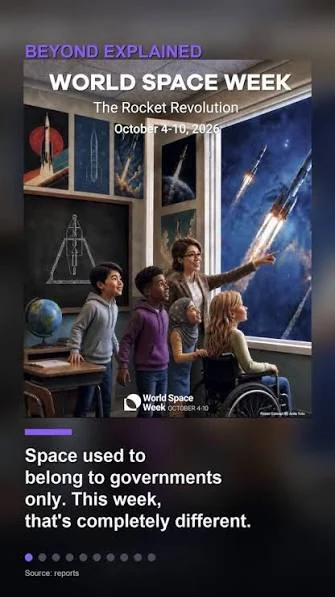
World Space Week 2026 runs from October 4 to 10, and it is widely described as the largest annual space event on Earth. Every year, schools, museums, space agencies, astronomy clubs, and families use this week to celebrate what humanity has achieved beyond the atmosphere and to inspire the next generation of scientists and engineers. This year the spotlight falls on rockets, the machines that make every satellite, probe, and crewed mission possible.
At AI Power Digest, we cover the places where technology, data, and the wider economy meet, and space now sits squarely in that territory. In this guide, we explain what the week is, why it happens in early October, what the “Rocket Revolution” theme means, how to take part safely, and how to tell genuine space news from hype. Whether you are a teacher planning a lesson, a parent looking for a weekend activity, or a tech reader curious about the launch industry, this article gives you a practical starting point.
A quick note before we begin: this article is for general education and information only. Where it touches on the space industry or business topics, nothing here is financial advice.
What Is World Space Week 2026?
Put simply, World Space Week 2026 is the newest edition of an annual celebration of space science and technology that was declared by the United Nations. It is not a single event in a single city. It is a shared seven-day window during which anyone, anywhere, can organize or join a space-related activity. A school science fair, a backyard telescope night, a university lecture on orbital mechanics, and a museum exhibit all count equally.
That openness is the whole point of World Space Week 2026. According to the organizers, any space-related activity held between October 4 and 10 qualifies, no matter how small it is or where it takes place. You can add your own activity to the official map through the World Space Week website, which also hosts themed resources and promotional material for schools and community groups.
A Week Built on Participation
Many awareness days are mostly symbolic. This one is different because its value comes from the number of people who actually do something. A teacher who runs a one-hour lesson on how rockets work is taking part in World Space Week 2026 just as fully as a national space agency hosting a public exhibition.
The Scale of the Celebration
The size of the event is impressive. In 2025, the celebration reached a record of nearly 50,000 events across 102 nations, according to the event’s own promotional material. The Planetary Society also notes that the week brings together schools, space agencies, museums, astronomy clubs, families, and individuals around the world, in its overview of the 2026 edition. Final participation figures for World Space Week 2026 will only be known after the week ends, so treat any early estimates with a little caution.
World Space Week 2026 Dates: Why October 4 to 10?
The dates are not random. Each end of the week marks a landmark moment in the story of spaceflight, and together they explain why the celebration blends science with international cooperation.
October 4, 1957: The Launch of Sputnik 1
The week begins on the anniversary of the launch of Sputnik 1 by the Soviet Union. It was the first artificial satellite to orbit the Earth, and it opened what we now call the Space Age. Sputnik was small, and it did little more than broadcast a simple radio signal. Yet its impact was enormous: it showed that reaching orbit was possible, and it kicked off decades of rapid technological development.
October 10, 1967: The Outer Space Treaty
The week ends on the anniversary of the day the Outer Space Treaty entered into force. This treaty set out foundational principles for the peaceful use of space, and you can read the background and the text through the United Nations Office for Outer Space Affairs. Pairing a technological milestone with a legal and diplomatic one is a deliberate choice. It reminds everyone that space is a shared domain, not just an engineering challenge.
December 6, 1999: The UN Declaration
The United Nations General Assembly formally declared October 4 to 10 as the annual week for celebrating space through resolution 54/68, adopted on December 6, 1999. Since then, the observance has grown from a modest idea into a truly global movement. For readers wondering when World Space Week 2026 happens each year, the answer is simple: the dates are fixed on the calendar and do not change.
The World Space Week 2026 Theme: “Rocket Revolution”
Each year, the World Space Week Association selects a theme in coordination with the United Nations Office for Outer Space Affairs. The theme gives programs around the world a common direction without limiting what people can do. The World Space Week 2026 theme is “Rocket Revolution,” and it is a timely choice.
What “Rocket Revolution” Actually Means
The theme explores how rockets have changed access to space and how people everywhere can take part through simple rocket activities. Organizers are inviting everyone to launch or release rockets during the week, while all other space-related events remain welcome. In other words, the theme is both a topic for discussion and an invitation to build and launch something yourself.
The Planetary Society describes the broader story behind the theme: the transformation of space launch from a handful of government programs into a diverse and fast-growing ecosystem of commercial providers, reusable rockets, and new space actors around the world. That is a useful way to think about it. Launch used to be the exclusive territory of a few national agencies. Today it is a competitive industry with many players.
Why Rockets Matter So Much
Every satellite you rely on, from the ones that support navigation and weather forecasting to the ones that carry communications and Earth observation, had to be lifted into orbit by a rocket. The cost, frequency, and reliability of launches therefore shape almost everything else in the space sector. When launch becomes cheaper and more frequent, more organizations can afford to build satellites, run experiments, and plan missions.
Reusability and the Changing Economics of Launch
One of the most talked-about shifts in the industry is reusability. Traditionally, rockets were expendable: after a single flight, the hardware was lost. Over the past decade, some companies have demonstrated that boosters can return and fly again. Reuse does not make spaceflight easy or risk-free, but it changes the economics and encourages a higher launch cadence. This is exactly the kind of change that makes the “Rocket Revolution” theme feel relevant to World Space Week 2026 and not merely nostalgic.
The Physics Behind It All
At the heart of every rocket is a principle you can demonstrate with a balloon: Newton’s third law of motion. A rocket pushes exhaust gas in one direction, and the gas pushes the rocket in the opposite direction. Real launch vehicles add enormous complexity, including staging, guidance, and carefully engineered engines, but the core idea is the same one your students can explore with a simple experiment.
Who Organizes World Space Week 2026?
Understanding who is behind World Space Week 2026 helps you find reliable information and, if you wish, get involved at a local level.
The World Space Week Association
The World Space Week Association is a non-governmental, non-profit organization. It works with national coordinators in dozens of countries and supports the United Nations in promoting the celebration. It publishes the annual theme, a media kit, and educational resources that anyone can use.
National Coordinators and Local Partners
In many countries, a national coordinating body adapts the global theme to local audiences. In the United Kingdom, for example, the British Interplanetary Society acts as the official coordinating body and organizes space-themed competitions around the week. In Pakistan, the national space agency SUPARCO has been the national coordinator since 2005. For World Space Week 2026, it has announced nationwide educational and public activities under the “Rocket Revolution” theme, including a university idea contest on rocket system design and a satellite design-and-build hackathon, as reported by Associated Press of Pakistan.
Honorary Chair and Industry Support
Event listings for the week indicate that Tory Bruno, the president and chief executive of United Launch Alliance, serves as the honorary chair for World Space Week 2026. Industry participation is a sign of how closely the celebration now connects education with the commercial space sector. If you want the latest details on speakers, partners, and activities, always confirm them on the official website rather than relying on third-party summaries.
How to Take Part in World Space Week 2026
You do not need a laboratory, a telescope, or a big budget. The organizers say activities can be as simple as a STEM lesson, a model or do-it-yourself rocket launch, a stargazing night, a space movie marathon, or a community event. Here is a practical menu of ideas for World Space Week 2026, grouped by who you are.
Ideas for Individuals
- Watch the sky. Spend an evening outdoors identifying constellations and planets with the naked eye or a basic star-chart app.
- Follow a mission. Choose a current mission from a major space agency and read about its goals, its timeline, and what it has already discovered.
- Learn the basics. Read an introduction to orbital mechanics or rocket staging, then explain it to a friend in your own words.
- Share your activity. Register your plans on the official map so that your effort is counted as part of World Space Week 2026.
Ideas for Families
- Build a straw rocket. A paper tube, a straw, and some tape are enough to explore thrust, drag, and stability.
- Hold a space movie night. Pick a documentary or a family film, then talk about which parts are real and which are fiction.
- Make a scale model of the solar system. Use household objects to show how far apart the planets really are.
Ideas for Clubs and Communities
- Host a public observing night. Local astronomy clubs can set up telescopes and invite neighbors to look at the Moon and planets.
- Organize a talk. Invite an engineer, a physics teacher, or a researcher to share what they do.
- Run a rocket workshop. Combine a short lesson on forces with a supervised launch activity.
Safe Rocket Activities for World Space Week 2026
Because the theme encourages launching and releasing rockets, a word about safety is essential. A good activity is memorable for the right reasons, and that means planning carefully.
Choose the Right Type of Rocket
For beginners, the safest and most affordable options are straw rockets, balloon rockets, and air-pressure or water-bottle rockets. Commercial model rocket kits are another option, but they involve small solid-fuel motors and are subject to rules that vary from country to country. Check local regulations and the manufacturer’s instructions before you launch anything.
Basic Safety Principles
- Supervise. Children should always have adult supervision, and a single person should be responsible for the launch area.
- Wear eye protection. Anyone close to the launch should wear safety glasses.
- Clear the area. Launch in an open space away from people, buildings, power lines, roads, and trees, and keep spectators at a safe distance.
- Respect pressure limits. Never pressurize a bottle or container beyond what it is designed to handle, and inspect it for cracks first.
- Never improvise with fuel. Do not make or use homemade explosive or combustible propellants. Stick to air, water, or commercially made, approved kits.
- Check the weather. Avoid launching in strong wind, and postpone if conditions are unsafe.
If you are organizing a public event, consider checking with your school, local authority, or venue to find out whether permission or insurance is required. Taking these steps does not dampen the fun. It simply means your contribution to World Space Week 2026 is one that everyone remembers positively.
World Space Week 2026 for Teachers and Schools
Few occasions are better suited to cross-curricular learning. Space touches physics, chemistry, mathematics, geography, history, art, and even ethics and law.
Lesson Ideas by Subject
- Physics: Explore Newton’s laws using balloon rockets and measure how far each one travels.
- Mathematics: Calculate speeds, distances, and scale models, or analyze data collected from a rocket launch activity.
- Geography: Discuss how satellites support mapping, weather monitoring, and disaster response.
- History: Compare the early Space Age with today’s more commercial and international landscape.
- Language and writing: Ask students to write a news report on the first day of a future mission.
- Civics and law: Introduce the idea behind the Outer Space Treaty and discuss why international rules matter.
Using the Official Resources
The World Space Week Association provides theme-specific resources, and national coordinators often add their own. Starting with these materials saves preparation time and keeps your lessons aligned with the global theme. If you run an event, registering it on the official map is a quick way to connect your class with others around the world who are taking part in World Space Week 2026.
Competitions and Challenges
Competitions can motivate students who might not otherwise engage with science. In some countries, national coordinators organize design contests, quizzes, and hackathons. These range from rocket system design challenges for university students to satellite-building competitions. Ask your national coordinator what is available near you, and encourage students to enter even if they feel they are beginners.
World Space Week 2026 for Families and Stargazers
Not every great activity involves building hardware. Sometimes the simplest approach is to step outside and look up.
Getting Started with Stargazing
You do not need expensive equipment. Many people begin with the naked eye, then move to binoculars, and later to a small telescope. Find a spot away from bright streetlights, give your eyes about twenty minutes to adjust to the dark, and use a red-filtered light if you need to read a chart so that you do not ruin your night vision. A free planetarium app can help you identify what you are seeing.
Making It a Conversation
The best stargazing sessions combine looking with talking. Ask children what they think is out there, how far away the Moon is, or how a rocket manages to leave the ground. You do not need to know all the answers. Looking them up together is part of the experience, and it is a wonderful way to spend an evening during World Space Week 2026.
Sharing with the Wider Community
If you enjoy the experience, consider inviting neighbors, friends, or members of a local club. Community observing nights are among the easiest events to organize, and they tend to be warm, welcoming, and free.
Why Tech Readers Should Care About World Space Week 2026
If your interests lean toward artificial intelligence, data, or the digital economy, space might seem like a separate world. It is not. Modern space systems generate and depend on huge amounts of data, and the technologies that process that data are advancing quickly.
Satellites as Data Sources
Earth-observation satellites capture images and measurements of oceans, forests, farmland, cities, and weather systems. Analysts increasingly apply machine learning to that imagery to help monitor crops, track environmental change, and support disaster response. Navigation and communications satellites underpin everything from logistics to mobile connectivity. The “Rocket Revolution” is, in part, a story about making it cheaper to put the sensors and relays that feed those systems into orbit.
Software, Autonomy, and Operations
Launch vehicles and spacecraft rely on sophisticated software for guidance, navigation, and fault detection. As the number of satellites grows, tracking objects in orbit and avoiding collisions becomes a data problem as well as a hardware problem. Many researchers and companies are exploring automation and artificial intelligence to help with these tasks, although human oversight remains central to safety-critical decisions.
A Natural Meeting Point
For technology enthusiasts, the week offers a chance to look beyond headlines and learn how launch, satellites, and software fit together. It is also an opportunity to ask better questions about who builds these systems, how they are regulated, and who benefits. That curiosity is exactly what the organizers hope to encourage through World Space Week 2026.
How to Evaluate Space Claims During World Space Week 2026
Whenever a topic becomes popular, marketing follows. The days around World Space Week 2026 are likely to bring a flood of space-themed articles, product launches, and promotions. Some will be excellent. Others will be exaggerated, misleading, or simply wrong. A few practical habits will help you tell the difference.
Check the Source
Start with the organizers and primary sources. For details about the observance itself, use the official World Space Week Association website, the United Nations Office for Outer Space Affairs, and recognized national coordinators. For mission and launch news, look to the space agencies and companies involved, and compare their statements with reputable independent reporting.
Watch for Red Flags
Be cautious about any offer that borrows the name of a United Nations observance, a space agency, or a well-known brand to sell a product. Space-themed tokens, collectibles, investment schemes, or “exclusive access” promotions that claim an official connection to the week should be verified before you share personal information or money. Promises of guaranteed returns, urgent deadlines, and pressure to act immediately are classic warning signs in any industry.
Separate Facts from Forecasts
Predictions about the size of the space economy, the timing of future missions, or the performance of companies are forecasts, not facts. When you see a number, ask who produced it, how it was calculated, and whether it has been independently verified. A forecast attributed to a named organization is more useful than an anonymous claim, and any prediction can turn out to be wrong.
A Simple Evaluation Checklist
- Who is making the claim, and what do they gain from it?
- Is there a primary source, such as an official document, dataset, or announcement?
- Is the date clear, and is the information still current?
- Are statistics explained, or are they just dropped in without context?
- Does the claim sound too good to be true?
This is educational guidance, not investment advice. Nothing in this article is a recommendation to buy, sell, or hold any asset, and anyone considering a financial decision should do their own research or speak with a qualified professional. Applying these habits will make your experience of World Space Week 2026 more informed and less stressful.
A Short History of Rocketry: Context for the Theme
To appreciate the “Rocket Revolution,” it helps to look back briefly. Rockets began as simple devices powered by black powder, used for centuries in ceremonies and warfare. In the early twentieth century, theorists and engineers began developing the mathematics and technology needed to reach space. The launch of Sputnik 1 in 1957 demonstrated that orbit was achievable, and the decades that followed saw satellites, crewed missions, space stations, and planetary probes.
For much of that period, launch was dominated by national programs. In more recent years, private companies and new national programs have joined the field, bringing competition, new designs, and new business models. The transformation did not happen overnight, and it has had setbacks as well as successes. Still, the direction of travel is clear: more actors, more launches, and more ways to use orbit. This is the story that World Space Week 2026 invites everyone to explore.
Frequently Asked Questions About World Space Week 2026
When is World Space Week 2026?
World Space Week 2026 takes place from October 4 to 10, as it does every year. The dates were set by the United Nations General Assembly in 1999.
What is the theme of World Space Week 2026?
The theme is “Rocket Revolution.” It focuses on how rockets have changed access to space and on the growing ecosystem of launch providers, reusable vehicles, and new participants around the world.
Why is World Space Week held on October 4 to 10?
The dates commemorate the launch of Sputnik 1 on October 4, 1957, and the entry into force of the Outer Space Treaty on October 10, 1967.
Who can take part in World Space Week 2026?
Anyone can take part. Schools, universities, space agencies, companies, clubs, families, and individuals are all welcome to organize or join an activity, and you can register yours on the official map.
Do I need special equipment to join World Space Week 2026?
No. A stargazing night, a classroom lesson, a space movie marathon, or a simple rocket-building activity requires very little equipment. If you do launch a rocket, follow safety guidance and local rules.
Who organizes World Space Week 2026?
The World Space Week Association, a non-governmental and non-profit organization, coordinates the observance with support from the United Nations Office for Outer Space Affairs and national coordinators in many countries.
Is World Space Week 2026 connected to any cryptocurrency or investment product?
Not as far as the official organizers’ materials show. The week is an educational and awareness event. If you encounter a token, collectible, or investment offer that claims an official link, verify it directly on the official website before engaging, and be cautious about any promises of returns.
How can teachers use World Space Week 2026 in the classroom?
Teachers can use the official theme resources, run simple rocket experiments, set cross-curricular projects, and join national competitions. Space connects naturally with physics, mathematics, geography, history, and writing.
Where can I find official information about World Space Week 2026?
The best starting point is the World Space Week Association website. National coordinators and the United Nations Office for Outer Space Affairs are also reliable sources for local programs and background information.
Conclusion: Make World Space Week 2026 Your Own
The beauty of World Space Week 2026 is its accessibility. You can mark World Space Week 2026 with a telescope on a hilltop, a straw rocket in a living room, a lecture in a packed hall, or a quiet evening spent reading about a distant mission. What matters is that you connect with the idea that space belongs to everyone, and that the people who explore it, from the first satellite builders to today’s launch teams and tomorrow’s students, started out with curiosity.
The “Rocket Revolution” theme captures an exciting moment. Launch is more diverse and more competitive than at any time in history, and that change affects science, education, technology, and the broader economy. If you want more clear explanations of technology trends, data, and the forces shaping the digital and physical worlds, keep following AI Power Digest for future guides.
Finally, keep your sense of wonder and your sense of skepticism in balance. Celebrate the achievements, ask good questions, verify claims, and share what you learn. Whatever you choose to do, make this World Space Week 2026 a week to remember.
Disclaimer: This article is provided for general informational and educational purposes only. It does not constitute financial, investment, legal, or professional advice, and nothing in it should be treated as a recommendation to buy, sell, or hold any asset. Event details, themes, and statistics may change, so please confirm current information with the official World Space Week Association and other primary sources. Always follow local laws, safety guidance, and manufacturer instructions when conducting rocket or other science activities.