
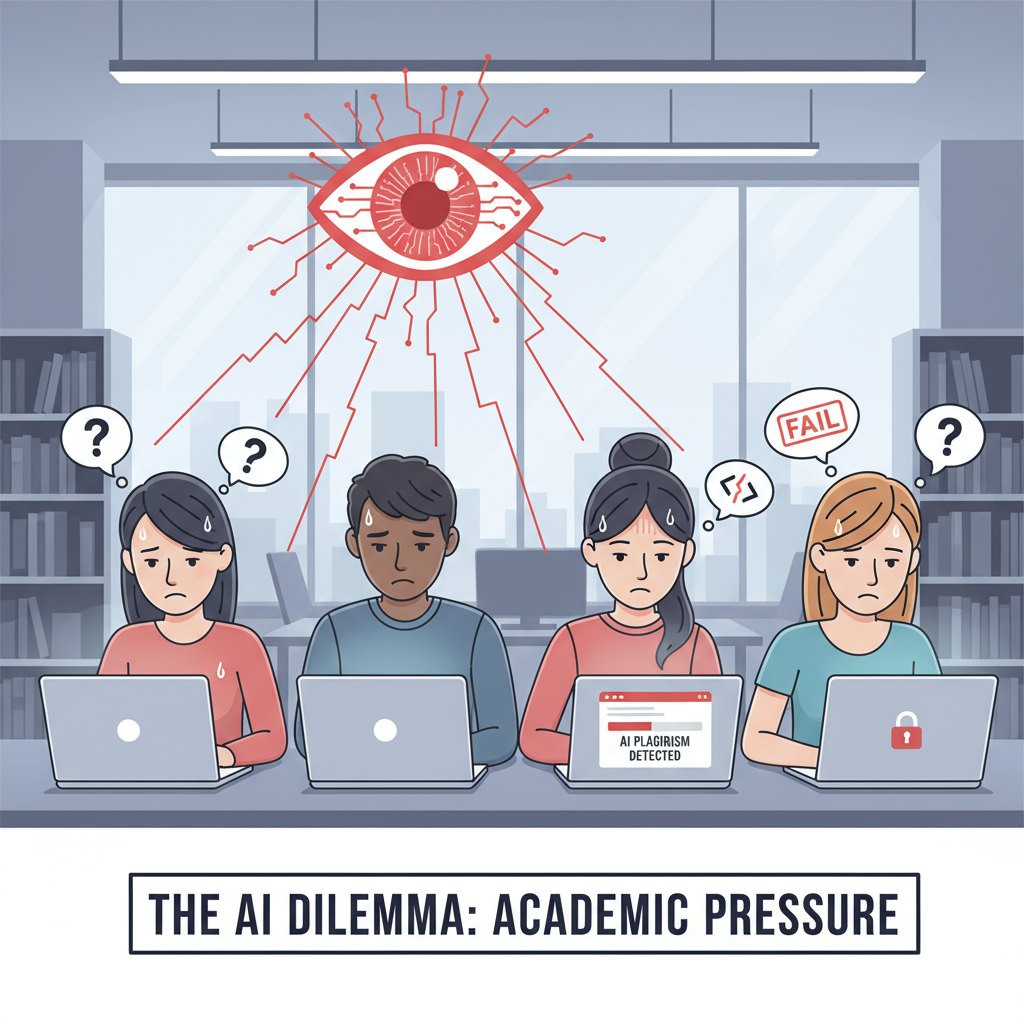
An AI detection tool promises something that sounds simple: tell you whether a piece of text was written by a human or a machine. In practice, the honest picture in 2026 is far messier than any single vendor’s marketing page suggests, because independent studies and vendor-reported benchmarks for the exact same AI detection tool frequently disagree by 30, 40, even 60 percentage points. Before you trust a score from any AI detection tool to make a decision about a student, an employee, or a piece of published content, it’s worth understanding why that disagreement exists and what these tools can and can’t reliably tell you.
This guide covers how an AI detection tool actually works, why accuracy claims vary so dramatically between vendor marketing and independent testing, what the most-cited academic research has found, how the leading tools compare, and a practical framework for using detection results responsibly rather than treating any single score as a verdict. For more explainers on technology and AI tools, visit AI Power Digest.
How an AI Detection Tool Actually Works
Most AI detection tools analyze statistical patterns in text, things like word predictability (sometimes called perplexity), sentence structure consistency (burstiness), and patterns learned from training on large samples of known human and AI-generated writing, to estimate the probability that a given passage was machine-generated. Some tools analyze an entire document and return a single score; others, like GPTZero, break results down sentence by sentence or flag specific passages, giving users more granular detail than a single overall percentage.
Critically, no AI detection tool actually “knows” whether text was AI-generated the way a watermark or cryptographic signature would prove it. Instead, every detector is making a probabilistic guess based on patterns, which is the root cause of both false positives (flagging human writing as AI) and false negatives (missing AI writing that doesn’t match the patterns the tool was trained to recognize).
Why AI Detection Tool Accuracy Claims Vary So Wildly
If you search for “best AI detection tool” you’ll find claims ranging from 99%+ accuracy to roughly 60%, often for the exact same product. Several structural reasons explain this gap.
Vendors benchmark against their own test sets. A company selling an AI detection tool naturally tests it under conditions favorable to its own model, often on raw, unedited AI output from a specific generation of language models, which tends to produce the highest possible accuracy numbers.
Independent studies use harder, more adversarial test conditions. Academic researchers testing an AI detection tool often include paraphrased, lightly edited, or “humanized” text specifically designed to evade detection, along with writing samples from non-native English speakers, both of which cause measurable accuracy drops across every tool tested.
The foundational academic study still shapes the conversation. According to the Wikipedia entry on AI content detection, a widely cited 2023 study by Weber-Wulff and colleagues evaluated 14 detection tools, including Turnitin and GPTZero, and found that “all scored below 80% of accuracy and only 5 over 70%.” The same research found that these tools tend to be biased toward classifying text as human rather than AI, and that accuracy worsens significantly once text has been paraphrased.
More recent testing shows the problem hasn’t disappeared. A June 2026 study comparing four detectors across 160 documents found that on fully AI-written papers, only one tool (Pangram) scored above zero under strict scoring, at 65%, while Turnitin, GPTZero, and Copyleaks each scored 0% in that specific test, according to the same Wikipedia summary of ongoing research. This stands in sharp contrast to vendor-reported figures claiming 95%+ accuracy for some of those same products, illustrating just how much test methodology shapes the headline number any AI detection tool reports about itself.
What Independent Testing Actually Shows
Rather than repeating any single vendor’s accuracy claim, here’s what a range of independent and semi-independent 2026 comparisons, each testing multiple tools under the same conditions, have found.
Raw, unedited AI text is detected reasonably well by top tools. In a 500-essay head-to-head test reported by StudySolutions, Turnitin led at 96% accuracy on unmodified AI output, followed by Originality.ai at 94% and GPTZero at 92%, with other tools trailing further behind.
Paraphrased or humanized text defeats most tools significantly. The same test found accuracy on paraphrased AI text dropped sharply across the board: Turnitin fell to 72%, Originality.ai to 68%, and GPTZero to 64%, a consistent 24 to 28 percentage point drop for every tool tested.
False positive rates remain a genuine, documented risk. According to the Weber-Wulff study cited on Wikipedia, GPTZero recorded a 50% false positive rate in that particular evaluation, while Turnitin recorded 0% false positives in the same study but subsequently failed to catch fully AI-written content in the 2026 follow-up testing, illustrating a recurring tradeoff: tools calibrated to avoid false accusations often miss more actual AI content, and tools calibrated to catch more AI content tend to misflag more human writing.
Real students have faced real consequences from these inconsistencies. The Wikipedia entry on AI content detection documents specific cases at the University of California, Davis, where students were referred to the university’s Office of Student Success and Judicial Affairs after professors scanned their human-written essays with GPTZero and Turnitin’s AI detection integration and received positive (AI-flagged) results.
Non-native English speakers face disproportionate false positives. Multiple sources, including the Wikipedia summary of ongoing research, note that AI detection software has been shown to discriminate against non-native English speakers, whose writing patterns can more closely resemble the statistical patterns these tools associate with AI generation.
Comparing the Leading AI Detection Tools
GPTZero
GPTZero is frequently cited as a strong choice for educators specifically, offering sentence-level detail and confidence categories rather than a single score. According to Eesel’s 2026 testing, GPTZero scored 95.7% on the RAID benchmark but only 63.77% in a separate head-to-head “Empirical Study” comparison against 14 other detectors, a gap that illustrates how dramatically results can shift between benchmarks. GPTZero offers a free tier alongside paid plans.
Turnitin
Turnitin remains deeply embedded in academic integrity workflows at many institutions, combining plagiarism checking with AI detection in a single platform. According to RewriteAI’s comparison, Turnitin notably declines to publish a single headline accuracy percentage, a position the analysis describes as “the most defensible position” among major vendors, given how much results vary by test methodology. Turnitin access is generally institutional rather than available to individual consumers.
Originality.ai
Positioned primarily at content marketers and SEO teams rather than educators, Originality.ai combines AI detection with plagiarism checking in a single workflow. Independent testing cited by Eesel found Originality.ai scored 97% in the Empirical Study benchmark and 96.7% on paraphrased content specifically, the strongest independent result on that harder measure among the tools reviewed, though other comparisons place its accuracy range more conservatively between roughly 76% and 94% depending on content type.
Copyleaks
Copyleaks is frequently cited for strong multilingual support, an advantage for organizations screening content across multiple languages rather than English exclusively, though head-to-head testing generally places it slightly behind the top two or three tools on raw accuracy.
Newer Entrants
Tools like Pangram have emerged more recently and, in at least one 2026 academic-style comparison, outperformed several more established names specifically on fully AI-written academic papers under strict scoring, a reminder that the competitive landscape for any AI detection tool continues shifting as both language models and detection techniques evolve.
What an AI Detection Tool Cannot Reliably Tell You
Given the inconsistency documented above, it’s worth being explicit about the limits of any AI detection tool, regardless of which one you use.
It cannot serve as definitive proof on its own. No detection score, however high, should be treated as conclusive evidence in a high-stakes decision, academic discipline, employment action, or content removal, given the documented false positive rates across every major tool.
It struggles disproportionately with edited or paraphrased text. If someone deliberately runs AI output through a paraphrasing tool or lightly edits it, every major AI detection tool shows significantly reduced accuracy, often dropping 25 points or more from its raw-text performance.
It may unfairly flag certain writing styles. Formal, simplified, or non-idiomatic English, common among non-native speakers, writers with certain learning differences, or even just methodical, repetitive technical writing, has been repeatedly documented as triggering higher false-positive rates across multiple tools.
Vendor-reported accuracy and real-world accuracy often diverge. As shown throughout this guide, the gap between a company’s own marketing claim for its AI detection tool and independent, adversarial testing results can be enormous, sometimes the difference between a 99% claim and a 60% independently measured result.
How to Use an AI Detection Tool Responsibly
Treat a detection score as one signal among several, never a standalone verdict. Combine it with other context: does the writing match the person’s known style and skill level? Is there a draft history or process documentation available? Are there other independent reasons to suspect the content’s origin?
Always allow for human review and appeal before any consequence is applied. Given the documented false-positive cases, including real students referred to disciplinary processes over what were ultimately human-written essays, building a review step into any policy that uses an AI detection tool is a basic fairness safeguard, not an optional extra.
Understand which tool your institution or organization actually uses, and its known limitations. If you’re a student or employee being evaluated with a specific AI detection tool, it’s reasonable to understand that tool’s documented accuracy range and false-positive history rather than assuming any detector is infallible.
Be skeptical of a single headline accuracy percentage from any source, including this guide. As demonstrated throughout this article, the “true” accuracy of any AI detection tool depends enormously on what specific text, language model, and editing condition was used to generate the test, so always check the methodology behind any number before treating it as definitive.
For content creators, don’t rely on a detector to “prove” your writing is human, or to test whether your AI-assisted writing will pass. Given how much accuracy varies by tool and test condition, optimizing your writing specifically to beat one detector offers no guarantee against a different tool, or the same tool updated with a newer model.
The Technical Signals Behind Detection Scores
Understanding the actual mechanics behind an AI detection tool’s score helps explain both its usefulness and its limitations in more concrete terms.
Perplexity measures how predictable a piece of text is to a language model. Human writing tends to include occasional unexpected word choices, tangents, and irregular phrasing, producing higher perplexity scores, while AI-generated text, particularly from earlier or less sophisticated models, often follows more statistically predictable patterns, producing lower perplexity. Detection tools built around this signal flag unusually low-perplexity passages as more likely to be machine-generated.
Burstiness looks at variation in sentence length and structure across a document. Human writers naturally mix short, punchy sentences with longer, more complex ones in an irregular pattern; some AI-generated text, especially from older model versions, tends to produce more uniform sentence lengths and structures, a pattern detection tools can pick up on.
Trained classifier models represent a more modern approach, where a detection tool is trained directly on large paired datasets of known human and known AI-generated text, learning more complex, less human-interpretable patterns than perplexity or burstiness alone. This approach, used by most current-generation tools, tends to perform better on raw text from the specific models it was trained against but can struggle more when facing output from a newer model it hasn’t seen before.
Why newer language models make detection harder. As language models have improved, their output has become more varied in sentence structure and less statistically predictable, closing some of the perplexity and burstiness gap that earlier detection approaches relied on. This is a core reason accuracy benchmarks for any AI detection tool tend to degrade over time against newer model outputs unless the detector itself is continuously retrained, which is also why a test conducted in early 2026 can show meaningfully different results than one conducted later the same year.
Industries and Contexts Where AI Detection Tools Are Used
While academic integrity is the most widely discussed use case, an AI detection tool is applied across several distinct contexts, each with different stakes and different tolerance for error.
Education. Instructors and institutions use detection tools, often integrated directly into existing plagiarism-checking platforms like Turnitin, to flag potentially AI-written student submissions for further review. This is also the context where documented false-positive harm has been most visible, given the direct academic consequences involved.
Content marketing and publishing. SEO teams and publishers use tools like Originality.ai partly to verify that purchased or outsourced content was genuinely written by the contracted writer, and partly because some search engines and content platforms have signaled interest in surfacing more clearly human-authored or at least human-reviewed content.
Hiring and recruitment. Some employers have begun using AI detection on candidate-submitted writing samples or take-home assignments, an emerging use case that carries similar false-positive risks to the academic context, since a wrongly flagged candidate may simply be rejected without any review process at all.
Journalism and fact-checking. News organizations and fact-checkers sometimes use detection tools as one input when verifying the authenticity of submitted user content, public comments, or suspected disinformation campaigns, generally alongside other verification methods rather than relying on detection scores in isolation.
Legal and compliance contexts. Some legal teams have begun exploring AI detection as part of broader document authenticity review, though this remains a newer and less standardized application compared to education or content marketing.
What to Do If You’ve Been Falsely Flagged
Given the documented false-positive rates covered throughout this guide, it’s worth knowing what reasonable steps look like if an AI detection tool incorrectly flags your own genuinely human-written work.
Request the specific report, not just the score. Tools like GPTZero provide sentence-level or passage-level detail rather than a single number; reviewing exactly which parts of your text were flagged can help you identify whether a pattern in your natural writing style (a formal register, consistent sentence structure, or a limited vocabulary on an unfamiliar topic) may have triggered the false positive.
Provide process evidence if available. Draft histories, document version timestamps, research notes, or outline drafts can help demonstrate an authentic human writing process, particularly in academic or employment contexts where a review process exists.
Point to the documented accuracy limitations. Given how well-established the false-positive problem is in published research, including the cases and studies referenced throughout this guide, it’s reasonable to cite that documented unreliability as part of an appeal or review request rather than assuming a single tool’s score is an unchallengeable final word.
Ask what tool was used and how it was calibrated. Different detection tools and different internal thresholds produce very different outcomes on the same text; understanding exactly which tool and settings were used can clarify whether the flag reflects a known weak point for that specific product.
The Arms Race Between Detection and Humanization Tools
No discussion of AI detection accuracy is complete without acknowledging the dedicated category of tools built specifically to defeat detection, often called “humanizers” or paraphrasing tools marketed explicitly for this purpose. These tools take AI-generated text and deliberately introduce the kind of irregular sentence structure, varied word choice, and unpredictable phrasing that detection tools rely on to spot machine-written content.
This creates a genuine arms-race dynamic: as detection tools improve at catching raw AI output, humanization tools adapt to specifically target whatever signal the latest detector relies on, and detection tools then need retraining against the newest humanization techniques. The paraphrased-text accuracy drops documented throughout this guide, often 24 points or more compared to raw-text performance, are a direct reflection of this ongoing back-and-forth. It also means that accuracy figures for any AI detection tool are inherently a snapshot in time rather than a permanent, stable number, since both sides of this dynamic continue evolving.
This dynamic is worth keeping in mind specifically because it undercuts any claim that a detection tool has “solved” the problem. A tool that performs well today against current humanization techniques may perform meaningfully worse within months as evasion methods adapt, which is one more reason to treat any detection score as a point-in-time signal rather than a permanent, reliable verdict.
Frequently Asked Questions
What is the most accurate AI detection tool in 2026?
There’s no single agreed-upon answer, because accuracy results vary enormously by study and test methodology. Vendor-reported figures often claim 95% to 99%+ accuracy, while independent, adversarial testing, particularly on paraphrased or humanized text, frequently shows significantly lower results, sometimes below 70%, for the same tools.
Can an AI detection tool be wrong?
Yes, regularly. Independent research, including the widely cited Weber-Wulff study referenced on Wikipedia, has documented false positive rates as high as 50% for some tools under certain test conditions, and real cases exist of human-written student essays being incorrectly flagged as AI-generated with serious academic consequences.
Does paraphrasing AI text help it avoid detection?
Yes, significantly. Across nearly every independent comparison reviewed for this guide, every major AI detection tool showed a substantial accuracy drop, commonly 24 to 28 percentage points, when evaluating paraphrased or lightly edited AI text compared to raw, unmodified AI output.
Is Turnitin or GPTZero more accurate?
It depends entirely on the test. Different studies have found each tool outperforming the other under different conditions; Turnitin has recorded lower false-positive rates in some studies but missed fully AI-written content entirely in a 2026 follow-up test, while GPTZero has shown higher raw detection rates in some comparisons but higher false-positive rates in others.
Why do AI detection tools flag non-native English speakers more often?
Research cited in academic and encyclopedic summaries of AI content detection has found that these tools can associate simplified sentence structure, more formal vocabulary choices, and other patterns common in non-native English writing with the statistical patterns the tools were trained to recognize as AI-generated, leading to disproportionate false positives for this group.
Should schools or employers rely solely on an AI detection tool to make decisions?
Based on the documented accuracy inconsistencies and false-positive cases covered in this guide, relying solely on any single AI detection tool’s score for a high-stakes decision carries real risk. Most responsible usage guidance suggests treating detection results as one input requiring human review and an appeals process, not a standalone verdict.
How much do AI detection tools typically cost?
Pricing varies by tool and use case. Several offer free tiers with limited usage, including GPTZero and ZeroGPT, while paid plans for tools like GPTZero and Originality.ai have been reported in roughly the $10 to $35 per month range for individual or small-team use, and Turnitin is typically licensed at the institutional level rather than sold directly to individuals.
Can I use an AI detection tool to check my own writing before submitting it?
You can, but treat any result with caution rather than as a pass/fail verdict. Because accuracy varies so much between tools and test conditions, a clean result from one detector doesn’t guarantee a different detector, or the same one updated with a newer model, would agree. Using a detector to self-check is more useful as a general sanity check than as proof of authenticity.
Are there ways to detect AI-generated images or other media, not just text?
Yes. Some tools, including Winston AI, have specifically added AI image detection capabilities alongside text detection, reflecting a broader expansion of this category beyond written content, though this guide’s focus and the research cited within it center primarily on text-based AI detection tools.
Conclusion: Treat Every Score as a Clue, Not a Verdict
The honest state of the AI detection tool category in 2026 is one of genuine, well-documented inconsistency. The same tool can be reported as 99% accurate by its own vendor and 64% accurate in an independent adversarial test, and tools that perform well on raw AI text frequently struggle significantly once that text has been paraphrased or lightly edited. None of this means these tools are useless, raw-text detection rates in the 90%+ range from top performers like Turnitin, Originality.ai, and GPTZero are genuinely meaningful signals, but it does mean no single score from any AI detection tool should be treated as definitive proof in a decision that affects someone’s education, employment, or reputation.
Whether you’re an educator evaluating student work, a content team verifying originality, or someone curious about your own writing, the responsible approach is the same: understand which specific tool you’re using, know its documented strengths and weaknesses, combine its output with other context and human judgment, and build in a path for review before any serious consequence is applied based on a detection score alone.
For more clear, practical explainers on technology and AI tools, visit AI Power Digest.
This article is for informational purposes only and does not constitute legal, academic-policy, or professional advice. Accuracy figures and benchmark results referenced reflect publicly available testing and reporting current as of 2026 and vary significantly by methodology; always verify current performance claims directly with each tool’s provider and consult your institution’s or organization’s specific policies before relying on any AI detection tool for a formal decision.