
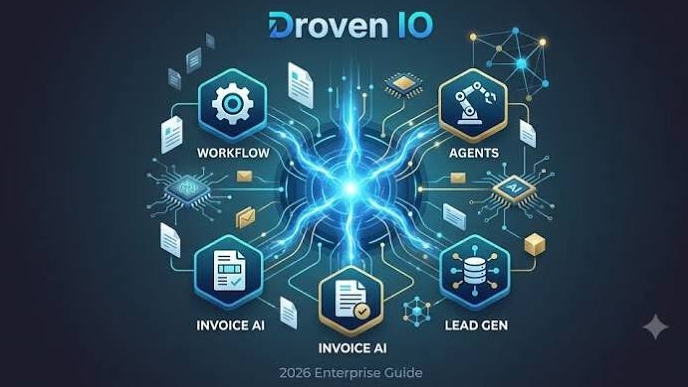
Overview of Droven.io AI Automation Tools and Architectural Taxonomy
The landscape of modern enterprise software is undergoing a fundamental structural transition from rigid, rule-based process execution to dynamic cognitive workflow engineering. Within this evolving paradigm, the term droven io ai automation tools represents both an overarching knowledge framework and a distinct class of workflow orchestration technologies designed to streamline cross-platform data flows, legacy system interactions, and intelligent decision-making. Public documentation and industry analyses reveal a dual identity for Droven.io, functioning as an educational knowledge platform that explains artificial intelligence, cloud computing, and robotic process automation (RPA), while also referencing specialized software interfaces engineered to simplify web application integration and natural language script generation.
Navigating this ecosystem requires evaluating how modern organizations integrate technical post-sales leader competencies developer tooling ai to bridges the gap between pre-sales architectural promises and long-term production stability. Enterprise automation projects frequently encounter deployment bottlenecks when attempting to scale from isolated proof-of-concept scripts to resilient, multi-departmental pipelines. Consequently, technical post-sales leaders must possess a deep understanding of software supply chain security, continuous evaluation (Evals) practices, context ownership mapping, and infrastructure economics to ensure that automation tooling yields measurable operational returns.
Modern business environments can no longer afford to operate isolated software applications that require manual data entry and human intervention for routine updates. The integration of intelligent layers allows organizations to process unstructured data, infer user intent, handle variations in customer phrasing, and execute complex multi-app routines with minimal latency. The broader architecture of droven io ai automation tools encompasses open-source agent runtimes like n8n, visual execution platforms like Make.com, expansive integration ecosystems like Zapier AI, localized business engines like GoHighLevel, and custom large language model (LLM) pipelines built on LangChain or CrewAI frameworks.
Quick Summary Table of Enterprise Automation Platforms
The following structured comparison evaluates the core platform archetypes documented within the droven io ai automation tools ecosystem, highlighting key operational metrics, integration mechanics, and technical requirements.
| Platform Framework | Primary Execution Mechanism | AI Integration Depth | Technical Skill Requirement | Primary Enterprise Target | Infrastructure Constraint |
| Droven.io Core Platform[cite: 4, 5] | Natural Language & Visual Drag-and-Drop | Workflow Generation & Browser RPA | Low to Intermediate | Rapid Prototyping & Business Tasks | Task-Based Subscription Scaling |
| n8n.io[cite: 1, 3] | Open-Source Self-Hosted Node Flow | Deep Agent Orchestration & Custom Code | Intermediate to Advanced | High-Volume Secure Data Pipelines | Infrastructure Maintenance Overhead |
| Make.com[cite: 1, 3] | Visual Directed Graph Builder | Modular AI Endpoints & Data Parsing | Low to Intermediate | Multi-Departmental Operations | Payload Transformation Latency |
| Zapier AI[cite: 1, 3] | Webhook & API Ecosystem Mapping | Prompt-Driven Micro-Automations | Non-Technical / Low | Broad SaaS App Interoperability | Per-Task Execution Expense |
| GoHighLevel[cite: 1, 2] | Consolidated Vertical CRM & Automation | Automated Communications & Lead Scoring | Low to Intermediate | Local Businesses & Marketing Agencies | Proprietary Vendor Ecosystem Lock-in |
| Custom LLM Stack (LangChain/CrewAI)[cite: 1, 3] | Python/TypeScript Agentic Runtimes | End-to-End Cognitive Decision Systems | Advanced Software Engineer | Unstructured Knowledge Systems | High Initial Engineering Investment |
| Devin AI Automations[cite: 15] | Autonomous Engineering Agent API | Self-Correcting Code & Task Execution | Advanced / API Driven | Complex Code Migrations & Workflows | Compute Consumption Costs |
Deep-Dive Analysis of Droven.io AI Automation Tools and Capabilities
Understanding the functional scope of droven io ai automation tools requires analyzing the underlying technical mechanisms that distinguish traditional deterministic automation from modern cognitive workflow engineering. Traditional automation engines operate on strict, immutable conditions where a specific input strictly yields a predefined output. While predictable, deterministic models break down when exposed to variable user behavior, unstructured document formats, or subtle semantic shifts in communication.
Cognitive automation platforms resolve these failure modes by incorporating machine learning models and large language model primitives directly into the workflow execution path. This structural evolution allows droven io ai automation tools to parse non-standard inputs, determine contextual intent, transform data schemas dynamically, and make bounded operational decisions before triggering downstream actions across cloud infrastructure.
Workflow Creation Abstractions and Natural Language Engines
A primary differentiation of modern platforms documented within the droven io ai automation tools framework is the abstraction of workflow construction through natural language processing. Rather than requiring developers to manually configure every API parameter, JSON schema, and HTTP header, operators can describe an intended business process in plain text. The platform’s underlying translation layer interprets the prompt, maps the implied requirements to available software connectors, and auto-generates a visual execution pipeline.
Visual workflow builders provide non-technical personnel with drag-and-drop canvases containing pre-built connectors for popular commercial SaaS applications, spreadsheets, email platforms, and relational databases. Simultaneously, template libraries store standardized automation routines—such as converting form submissions into CRM records or parsing incoming PDF invoices—reducing initial setup friction and establishing reference implementations for enterprise users.
Cognitive Lead Generation and Real-Time Qualification Engines
Inbound lead generation represents one of the most commercially significant applications for droven io ai automation tools. Traditional lead generation pipelines suffer from manual data entry delay, inconsistent lead scoring, and delayed outreach, which severely degrade conversion rates. By embedding machine learning models directly into lead capture workflows, organizations can automatically enrich prospect data, evaluate buying intent, and trigger personalized follow-up sequences within seconds of initial engagement.
The automated qualification mechanism processes behavioral signals—such as website browsing depth, dynamic content interaction, and form response velocity—to calculate a real-time lead score. Leads meeting specific high-intent thresholds are immediately pushed to active sales queues within enterprise CRMs, while lower-scoring prospects are routed into automated, context-aware email sequences that adjust messaging content based on continuous prospect interactions. This automated responsiveness eliminates human latency and ensures consistent pipeline management without expanding sales headcount.
Conversational AI Architectures and Retrieval-Augmented Generation
Conversational front-ends built into droven io ai automation tools extend far beyond basic decision-tree chatbots. Advanced implementations leverage Retrieval-Augmented Generation (RAG) to connect conversational interfaces with internal enterprise data repositories, policy manuals, and product knowledge bases. This architecture ensures that dynamic AI agents produce accurate, contextually relevant responses grounded strictly in verified institutional data.
The operational intelligence of these conversational systems relies on semantic intent discrimination. For instance, when a customer submits an inquiry regarding order status, the underlying system distinguishes between an informational request for policy details and an actionable execution request to modify a shipping address. If a conversation strays beyond predefined operational boundaries or exhibits negative user sentiment, the system executes a deterministic escalation protocol, transferring the full transcript and extracted context to a human operator.
Back-Office Robotic Process Automation and Document Parsing
While modern web applications interact seamlessly via REST and GraphQL APIs, enterprise back-office operations frequently rely on legacy software systems that lack native API interfaces. Droven.io AI automation tools incorporate Robotic Process Automation (RPA) capabilities to bridge this interface gap through screen-level browser automation and optical character recognition (OCR).
Single-process RPA bots emulate human user interactions by dynamically navigating web portals, inputting form fields, extracting data tables, and downloading operational reports. When coupled with vision-enabled LLMs, these tools can automatically parse unstructured financial documents, cross-reference invoice details against internal purchase orders, and reconcile accounting ledgers across disparate software systems without requiring manual keyboard entry.
Technical Post-Sales Leader Competencies in Developer Tooling AI
Deploying droven io ai automation tools within complex enterprise environments requires specialized technical post-sales leadership. The convergence of developer tooling and artificial intelligence has transformed post-sales engineering from a reactive support role into a strategic engineering function. Technical post-sales leaders act as the definitive link between external customer engineering teams and internal product development, ensuring that complex AI platforms deliver reliable production outcomes.
┌────────────────────────────────────────────────────────────────────────────────────────┐
│               TECHNICAL POST-SALES LEADER COMPETENCY LIFECYCLE                         │
├────────────────────────────────────────────────────────────────────────────────────────┤
│ 1. TECHNICAL DISCOVERY & POV SCOPING                                                   │
│    ├── Align business objectives with technical feasibility & API limits                │
│    └── Whiteboard containerized cloud architectures & enterprise data flows            │
├────────────────────────────────────────────────────────────────────────────────────────┤
│ 2. AGENTIC ENGINE IMPLEMENTATION & EVALS                                               │
│    ├── Implement Model Context Protocol (MCP) & canonical context mapping               │
│    └── Construct quantitative Evaluation (Evals) suites for precision & latency        │
├────────────────────────────────────────────────────────────────────────────────────────┤
│ 3. DEVOPS, SECURITY & SUPPLY CHAIN GOVERNANCE                                          │
│    ├── Manage Docker/Kubernetes container orchestrations & base-image patching          │
│    └── Enforce SBOM scanning, secret management, and role-based access controls        │
├────────────────────────────────────────────────────────────────────────────────────────┤
│ 4. COMPUTE ECONOMICS & ACCOUNT EXPANSION                                               │
│    ├── Model API token consumption unit economics & GPU infrastructure margins        │
│    └── Analyze production telemetry to prove ROI and drive platform expansion          │
└────────────────────────────────────────────────────────────────────────────────────────┘
Strategic GTM Alignment, Discovery, and Proof-of-Value Execution
A core competency for post-sales leaders in developer tooling AI is the ability to conduct rigorous technical discovery and lead Proof-of-Value (POV) engagements. Rather than presenting standardized product demonstrations, these leaders must analyze customer source code, existing CI/CD pipelines, and active cloud environments to architect tailored integration strategies.
During the pre-to-post-sales transition, the leader defines explicit, measurable success criteria for customer pilots, such as reducing workflow execution latency, minimizing API failure rates, or achieving targeted intent classification accuracy. By whiteboarding containerized deployment patterns and handling technical objections around platform boundaries, post-sales leaders establish architectural credibility with customer engineering executives.
Agentic Engineering Primitives and Context Architecture
As automation tools transition from static scripts to dynamic agentic workflows, technical post-sales leaders must master modern AI primitives, including the Model Context Protocol (MCP), tool-use schemas, and canonical context mapping. AI agents require clear, structured context boundaries to interact safely with enterprise software platforms without exposing sensitive internal data or triggering erroneous API actions.
Enterprise Data Sources ──► Model Context Protocol (MCP) ──► Context Boundary Filter ──► Agentic AI Engine ──► Execution Sandbox
Post-sales leaders design context ownership maps that define precisely which internal databases, document stores, and SaaS endpoints an agent can query during workflow execution. Furthermore, they champion the institutional implementation of systematic evaluation practice (Evals). By establishing robust evaluation frameworks, leaders continuously benchmark model performance, prompt adjustments, and tool invocation accuracy against real-world production logs, ensuring high outputs prior to full enterprise rollout.
DevOps Leadership, Containerization, and Supply Chain Security
Enterprise adoption of droven io ai automation tools demands strict compliance with modern DevOps practices and security standards. Technical post-sales leaders must possess hands-on proficiency with container orchestration platforms, such as Docker, Kubernetes, and Rancher, to guide customer platform teams through reliable runtime installations.
CI/CD Pipeline ──► Base Image Scanning ──► SBOM Verification ──► Container Registry ──► Kubernetes Orchestration
Security governance requires establishing software supply chain integrity. Post-sales leaders enforce automated base-image vulnerability scanning, dependency governance, Software Bills of Materials (SBOM) tracking, dynamic secret management, and least-privilege Role-Based Access Control (RBAC). When pipeline failures or platform incidents occur, these leaders direct root-cause analysis, isolated sandbox debugging, and zero-downtime corrective deployments to ensure continuous operational uptime.
Compute Economics, Observability, and Margin Optimization
Running high-volume AI workflows introduces complex financial variables tied to LLM token consumption, API calls, and cloud compute infrastructure. Technical post-sales leaders must operate as financial engineers, analyzing token unit economics and compute margins to prevent cost overruns.
Post-sales leaders configure enterprise observability stack tracing that monitors pipeline throughput, execution duration, token expenditure, and memory utilization in real time. By reviewing failed execution trajectories and optimizing payload sizes, leaders help customer teams trim unnecessary API overhead, maximize compute efficiency, and clear financial pathways for expansion across additional business units.
Enterprise Evaluation: Pros, Cons, and User Sentiment
Selecting an enterprise automation framework requires a balanced assessment of operational advantages against inherent architectural constraints. The following table synthesizes the primary system advantages, limitations, and user feedback associated with platforms operating within the droven io ai automation tools ecosystem.
| Functional Dimension | Systematic Strengths (Pros) | System Limitations (Cons) | Synthesized Market & User Sentiment |
| Ease of Use & Onboarding | Intuitive visual builders and natural language workflow setup lower barriers for business units. | Complex conditional logic and advanced state management require manual code injection. | Highly praised by non-technical teams for fast initial setup, though developers cite UI clutter on complex workflows. |
| Integrations & Ecosystem | Extensive libraries of pre-built connectors cover popular cloud CRM, communication, and storage SaaS tools. | Custom legacy protocols and on-premise databases require building bespoke proxy API wrappers. | Users report excellent out-of-the-box utility for standard cloud tools, but note friction with legacy enterprise systems. |
| In-Workflow Intelligence | Simplifies initial workflow design by interpreting plain-language functional instructions. | Embedded LLM processing capabilities are less customizable than open-source agent frameworks. | Business users value quick AI drafting; technical teams prefer open-source frameworks for complete model control. |
| Reliability & Debugging | Reliable, predictable execution for straightforward single-app and dual-app task automations. | Production reliability degrades when handling complex, non-deterministic multi-loop workflows. | Operations teams cite occasional silent execution failures during external API structure changes. |
| Cost & Scaling Dynamics | Low barriers to entry with affordable starting subscription tiers for small business testing. | Task-based pricing models introduce exponential cost growth during high-volume execution runs. | Mid-market enterprises voice concern over unpredictable billing spikes when workflows scale across departments. |
System Strengths and Operational Advantages
The primary benefit of adopting platforms within the droven io ai automation tools landscape is the rapid acceleration of operational time-to-value. By utilizing pre-built software connectors and template libraries, business operations teams can deploy functional automations within hours, bypassing lengthy software development cycles.
Furthermore, visual workflow builders reduce reliance on dedicated software engineering capacity for routine operational tasks. Non-technical staff can independently configure notification hooks, spreadsheet updates, and simple lead routing pipelines, allowing core engineering teams to focus on proprietary product development.
System Vulnerabilities and Implementation Gaps
Despite user-friendly interfaces, managed cloud SaaS automation tools exhibit structural limitations when deployed for mission-critical enterprise operations. A primary concern is the reliability gap that emerges as workflows grow in complexity. Cloud platforms designed for broad consumer use often lack granular transaction control, explicit state rollback mechanisms, and advanced error handling queues required for high-reliability data processing.
Another vulnerability is vendor lock-in and proprietary schema constraints. Automations constructed within proprietary visual builders store workflow definitions in platform-specific formats, preventing direct export to open-source agent runtimes like n8n or custom Python codebases. Additionally, while natural language assistants simplify initial setup, embedding dynamic AI decision-making within active workflow steps often requires external API calls that introduce operational latency and incremental per-task costs.
Financial Models, Implementation Pricing, and Total Cost of Ownership
Calculating the total cost of ownership (TCO) for droven io ai automation tools requires evaluating direct subscription fees, token usage pricing, infrastructure host costs, and required engineering maintenance capital. Enterprise buyers must distinguish between entry-level SaaS pricing and the fully loaded financial investment required for long-term production deployment.
SaaS Task Subscriptions ──► Direct Per-Task Billing ──► High Volume Scaling Spikes
Self-Hosted Platforms   ──► Fixed Hosting Costs    ──► Engineering Maintenance Overhead
Custom LLM Architectures──► Token API Usage Costs  ──► Requires Token Budget Caps & Evals
Comparative Pricing Architecture Matrix
| Platform Tier | Entry Pricing Model | Estimated Monthly Recurring Expense | Primary Cost Driver | Financial Risk & Volatility |
| Visual SaaS Tools (Droven/Make/Zapier)[cite: 4, 5] | Freemium to Task-Based Tiers | $20 to $500+ / month | Monthly task executions & step volume | High risk of cost spikes during automated loop iterations |
| Self-Hosted Open Source (n8n)[cite: 1, 3] | Free Codebase / Hosted Cloud Option | $50 to $300 / month (Cloud Host) | Server memory, CPU cores, and storage | Low recurring cost volatility; predictable infrastructure bills |
| Enterprise Custom LLM Pipeline[cite: 1, 3, 5] | Pay-as-you-go API + Custom Build | $500 to $5,000+ / month | Model token counts, vector DB queries | High; requires active token budget caps and prompt tuning |
| Vertical CRM Engines (GoHighLevel)[cite: 1, 2] | Fixed Monthly Multi-Tenant License | $97 to $497 / month | Sub-account count & carrier SMS fees | Moderate; costs scale with external communications messaging volume |
Practical Deployment Capital Requirements
Deploying production-grade automations involves initial setup capital alongside recurring operational expenses. Building and deploying a single-process RPA bot—such as an automated invoice parsing script or onboarding pipeline—typically requires an upfront investment ranging from $1,500 to $4,000 for small business implementations.
For multi-system enterprise workflow architectures—where multiple departments share a unified data layer across custom APIs, security controls, and machine learning models—implementation budgets range between $5,000 and $15,000. Organizations must factor these deployment costs into ROI projections alongside ongoing token consumption and hosting fees.
Enterprise Deployment Methodology and Implementation Roadmap
Successfully operationalizing droven io ai automation tools across an enterprise requires adhering to a structured four-phase implementation framework. This methodology minimizes technical debt, enforces security governance, and ensures continuous operational stability.
Phase 1: Security & Governance Baseline Setup
  ├── Deploy Docker/Kubernetes containerized runtime environment
  ├── Configure secrets isolation, SSO integration, and RBAC policies
  └── Establish base image vulnerability scanning & SBOM tracking

Phase 2: Workflow Topology & Context Boundary Engineering
  ├── Define explicit JSON schemas for all API webhooks & payloads
  ├── Map canonical context boundaries via Model Context Protocol (MCP)
  └── Implement explicit error routing and fallback escalation queues

Phase 3: Sandbox Validation, Evals & Edge-Case Auditing
  ├── Execute synthetic payload tests across diverse input conditions
  ├── Conduct quantitative model Evals for accuracy, recall & latency
  └── Enforce hard execution loop caps to prevent recursive token drain

Phase 4: Telemetry Instrumentation & Production Rollout
  ├── Instrument monitoring dashboards tracking token, task & memory usage
  ├── Establish automated CI/CD base image updates & security patching
  └── Measure production ROI to justify platform expansion
Phase 1: Security, Governance, and Infrastructure Baseline
Initial setup begins by establishing a secure execution environment. Organizations deploy isolated container runtimes using Docker and Kubernetes, ensuring that workflow execution engines remain decoupled from host system dependencies.
Authentication controls must incorporate enterprise Single Sign-On (SSO) and strict Role-Based Access Control (RBAC) schemas based on least-privilege principles. All API credentials, tokens, and database passwords must be managed through secure secrets vaults rather than hardcoded in workflow scripts. Finally, platform engineers configure automated vulnerability scanning for all underlying container base images and establish Software Bill of Materials (SBOM) tracking to safeguard the software supply chain.
Phase 2: Workflow Topology and Context Boundary Engineering
With infrastructure secured, engineering teams map visual workflow topologies and define explicit API interaction rules. Developers define strict JSON schemas for inbound webhooks and outbound API requests to prevent malformed data payloads from causing execution errors.
For automations utilizing large language models, post-sales leaders establish canonical context maps using frameworks like the Model Context Protocol (MCP). This step defines precisely what enterprise data is exposed to AI models during specific execution steps, preventing data leakage across unauthorized boundaries. Furthermore, developers engineer explicit fallback routes, ensuring that API timeouts or low-confidence AI decisions automatically escalate to human monitoring queues.
Phase 3: Sandbox Testing, Evals, and Edge-Case Auditing
Prior to production deployment, automations undergo testing within isolated sandbox environments. Quality assurance teams execute synthetic data payloads designed to simulate both standard operational conditions and extreme edge cases.
Systematic evaluation suites (Evals) assess the precision, recall, and intent-classification accuracy of embedded AI components. Testers audit prompt trajectories to confirm that output formats strictly conform to downstream platform requirements. Additionally, execution scripts are audited to verify that hard loop counters are active, preventing uncontrolled recursive loops from consuming excess API tokens or triggering rate limits.
Phase 4: Telemetry Instrumentation, Production Rollout, and Optimization
Upon completing validation, workflows are deployed to production environments accompanied by real-time observability telemetry. Monitoring dashboards track key performance indicators, including execution success rates, API latency, memory utilization, and token expenditures.
Automated CI/CD pipelines manage ongoing maintenance, applying security patches and dependency updates without interrupting active workflows. Technical post-sales leaders review operational telemetry alongside business leads, quantifying recovered labor hours, conversion improvements, and overall system return on investment. These operational metrics validate platform performance and provide data-backed rationale for scaling automation capabilities into additional business units.
Frequently Asked Questions Regarding Droven.io AI Automation Tools
What is the precise definition of Droven.io AI automation tools?
Droven.io AI automation tools refers to a modern category of intelligent workflow platforms, robotic process automation engines, and conversational AI systems documented and evaluated by the Droven.io tech knowledge platform. The category spans low-code cloud services like Make.com and Zapier AI, open-source agent environments like n8n, CRM automation systems like GoHighLevel, and bespoke LLM integration pipelines.
How do Droven.io AI automation tools differ from traditional IT script automation?
Traditional IT script automation relies on deterministic “if-then” rules that require exact structured inputs to function properly. Droven.io AI automation tools incorporate machine learning and large language models to interpret natural language instructions, process unstructured document formats, dynamically handle input variations, and execute complex multi-step routines across cloud platforms.
Why are technical post-sales leader competencies critical when deploying developer tooling AI?
Deploying enterprise developer tooling AI involves navigating non-deterministic output behaviors, complex API connections, security governance, and variable compute costs. Technical post-sales leaders possess the expertise required to scope Proof-of-Value pilots, establish quantitative evaluation (Evals) suites, manage containerized infrastructure, and optimize token economics, ensuring projects transition successfully from prototype to production.
What is the financial cost difference between self-hosting n8n and subscribing to cloud SaaS automation tools?
Subscribing to cloud SaaS automation tools requires minimal upfront investment but incurs monthly task-based fees that scale rapidly as workflow volume grows. Self-hosting open-source engines like n8n involves an upfront engineering setup cost ($1,500 to $4,000 for basic deployments) but delivers lower, predictable monthly hosting costs, making it significantly more cost-effective for high-volume execution workloads.
How do token limits and API execution caps protect enterprise automation budgets?
Token limits and execution caps place strict boundaries on the number of LLM queries and recursive loops a workflow can perform during a single run. Without execution caps, malformed data or unexpected API errors can trigger infinite execution loops, quickly exhausting API credits and incurring unexpected infrastructure costs.
Strategic Recommendations and Institutional Next Steps
The evaluation of droven io ai automation tools highlights a fundamental shift toward intelligent operational infrastructure. For enterprise organizations seeking to enhance efficiency through modern workflow engineering, success depends on aligning tool selection with actual internal engineering resources and operational requirements.
Small Scale & Fast Setup  ──► Managed Visual SaaS (Make / Zapier / Droven)
High Volume & Data Control ──► Self-Hosted Runtimes (n8n.io Docker Stacks)
Proprietary & Complex Logic ──► Custom LLM Frameworks (LangChain / Python APIs)
Non-technical business units handling straightforward administrative tasks can leverage low-code visual automation platforms for rapid deployment and quick operational gains. However, technical teams managing high-volume, mission-critical data flows should adopt self-hosted open-source runtimes or bespoke LLM microservice pipelines.
To ensure long-term stability and ROI, institutions must invest in technical post-sales leadership capable of enforcing supply chain security, managing context boundaries, and continuously auditing model performance. By combining visual workflow tools with structured developer governance, organizations can build scalable, cognitive automation ecosystems that drive lasting competitive advantage.
This document is provided for informational and educational purposes only. For specific medical, legal, or health-related inquiries, consult a qualified professional.