
If you’ve been trying to keep up with the Wisconsin governor race, you’re not alone. Between a crowded primary, a last-minute comeback, and a photo-finish result, this has been one of the more chaotic governor’s races in the country this year.
Wisconsin is one of the closest states in America, and this year’s contest to replace Governor Tony Evers is shaping up to be just as tight. Whether you’re a lifelong Wisconsin voter or just trying to understand why this race keeps making national headlines, this guide breaks down everything that’s happened so far and what comes next.
We’ll walk through the Wisconsin governor race candidates, the primary results, the key issues on the table, and what to expect heading into November.
Why the Wisconsin Governor Race Matters in 2026
This isn’t just another statewide election. For the first time since 2010, Wisconsin’s governor, state Senate majority leader, and state Assembly speaker are all leaving office at once. That creates a rare open-field moment in state politics.
Add to that the fact that Wisconsin is a genuine swing state — one that has voted with the winner of the last five presidential elections — and you can see why both parties are treating this contest as a must-win.
A few reasons the race carries extra weight this cycle:
- It’s an open seat, with no incumbent running
- Wisconsin’s legislature is currently controlled by Republicans, while the governor’s office has been Democratic since 2019
- The outcome could shape redistricting, budget priorities, and abortion policy for years
- National figures, including President Trump, have already weighed in with endorsements
Wisconsin Governor Race Candidates: Who Was on the Ballot
Understanding the full field helps make sense of how we got here. The Wisconsin governor race candidates list started out large and narrowed quickly as the primary approached.
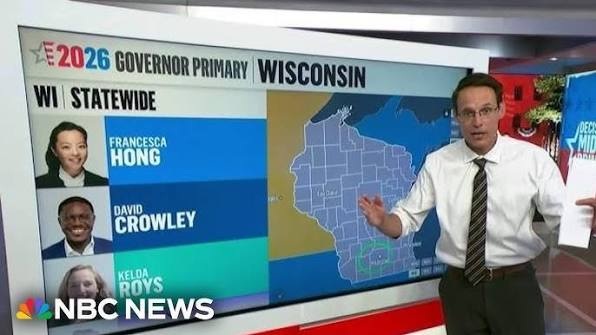
On the Democratic side, four candidates made it to the ballot on primary day: Milwaukee County Executive David Crowley, state Assembly member Francesca Hong, former Discovery World president Joel Brennan, and former state Rep. Kelda Roys. A few other Democrats, including Sara Rodriguez, had dropped out earlier in the campaign, though some names remained on the ballot.
On the Republican side, the field was much smaller. Congressman Tom Tiffany ran with President Trump’s endorsement, facing only minor opposition from Andy Manske, a medical professional with limited name recognition statewide.
A Quick Snapshot of the Main Candidates
- David Crowley (D) — Milwaukee County Executive, backed late in the race by Gov. Tony Evers
- Francesca Hong (D) — State Assembly member and democratic socialist, the early frontrunner in polling
- Tom Tiffany (R) — Sitting U.S. Congressman, endorsed by President Trump
- Andy Manske (R) — Long-shot Republican challenger
Democratic Primary: Crowley’s Narrow Win Over Hong
This is where the Wisconsin governor race got genuinely dramatic. David Crowley briefly dropped out of the race in early July, then jumped back in about ten days later after Gov. Evers offered his endorsement.
That comeback paid off, but barely. Crowley and Hong were locked in a virtual tie through most of election night, with the race still too close to call even after 84% of votes had been counted.
Hong, a democratic socialist who hoped to ride the same wave of progressive energy seen in recent races in Michigan, New York, and Colorado, built a campaign around bringing new and younger voters into the process. She led in early polling and pulled in enthusiastic crowds throughout the summer.
In the end, Crowley’s more moderate, establishment-backed campaign edged her out. Hong conceded once it became clear a recount wouldn’t change the outcome, telling supporters the movement she built would be “remembered forever.”
Republican Primary: Tom Tiffany’s Path to the Nomination
Compared to the nail-biter on the Democratic side, the Republican primary was fairly straightforward. Tom Tiffany, a congressman representing Wisconsin’s northwestern 7th District, entered the race as the clear frontrunner thanks to President Trump’s early endorsement.
Tiffany previously served in both the state Assembly and state Senate before winning his congressional seat in 2020. His campaign has centered on:
- Freezing property taxes
- Increasing school funding
- Easing regulations on energy, housing, and childcare
- Taking a tougher stance on crime and immigration
His only real primary opponent, Andy Manske, never posed a serious threat, and Tiffany secured the nomination comfortably.
Key Issues Shaping the Wisconsin Governor Race
Every governor’s race has its defining issues, and this one is no different. As the general election campaign kicks off, a handful of topics are dominating the conversation.
Affordability and Property Taxes
Both parties are talking about cost of living, though their solutions look very different. Crowley has focused on housing affordability and school funding reform, while Tiffany is pushing for a property tax freeze paired with deregulation.
Healthcare Access
Healthcare, especially for children and families, has come up repeatedly on the campaign trail. Several Democratic candidates, including Brennan before he dropped out, made expanded coverage a central plank of their platforms.
Federal-State Relations
With Trump in the White House, questions about how a Wisconsin governor would respond to federal actions on immigration enforcement and election oversight have become a recurring theme, particularly among Democratic candidates.
What Happens Next in the Wisconsin Governor Race
With the primary now decided, the Wisconsin governor race moves into its general election phase. David Crowley and Tom Tiffany will face off on the ballot on November 3, 2026.
Here’s what to expect in the coming months:
- Both campaigns will shift focus toward swing counties and independent voters
- Fundraising and outside spending are expected to ramp up significantly
- Debates and public forums will likely be scheduled through September and October
- National attention will grow, given Wisconsin’s status as a presidential battleground state
Analysts widely consider this race a toss-up, largely because of Evers’ retirement and the state’s near-even partisan split.
How the Lieutenant Governor and Down-Ballot Races Fit In
The governor’s race isn’t happening in isolation. Wisconsin voters will also decide the lieutenant governor’s race, along with contests for attorney general, the state Senate, and all 99 seats in the state Assembly.
On the Democratic side, current Secretary of State Sarah Godlewski is running for lieutenant governor. Republicans will choose their nominee between Will Martin and David Varnam.
Down the ballot, incumbent Attorney General Josh Kaul, a Democrat, is seeking a third term against Republican challenger Eric Toney. With Republicans currently holding a narrow edge in the state Senate, several individual legislative races could end up mattering just as much as the top of the ticket.
What This Race Means for Wisconsin’s Political Future
However the Wisconsin governor race turns out in November, it marks a genuine turning point for the state. This is the first open-seat governor’s race since 2010, and it’s happening at the same time as major turnover in legislative leadership.
For Democrats, holding the governor’s office would preserve a check on the Republican-controlled legislature. For flipping the seat would give the party control of the executive branch for the first time since Scott Walker left office.
Either way, the winner will inherit a state that’s almost perfectly split between the two parties, meaning the next governor will need to govern from the middle to get much of anything done.
Frequently Asked Questions About the Wisconsin Governor Race
Who is running in the Wisconsin governor race in 2026?
Following the August 11 primary, the two main candidates are Democrat David Crowley, the Milwaukee County Executive, and Republican Tom Tiffany, a sitting U.S. Congressman endorsed by President Trump. They’ll meet in the general election on November 3, 2026.
Who won the Wisconsin governor primary?
David Crowley narrowly defeated Francesca Hong in an extremely close Democratic primary, while Tom Tiffany easily won the Republican nomination over Andy Manske.
When is the Wisconsin general election for governor?
The general election is scheduled for November 3, 2026. The primary that narrowed the field took place on August 11, 2026.
Why isn’t Tony Evers running for governor again?
Evers announced in July 2025 that he would not seek a third term, opening up the race for the first time since he was first elected in 2018.
Is the Wisconsin governor race considered competitive?
Yes. Political analysts widely view it as a toss-up, given Wisconsin’s history as a swing state and the fact that there’s no incumbent on the ballot this cycle.
Who is running for lieutenant governor in Wisconsin?
Sarah Godlewski, the current Secretary of State, is the Democratic nominee for lieutenant governor. Republicans are choosing between Will Martin and David Varnam.
Where can I find official Wisconsin governor race results?
The Wisconsin Elections Commission publishes official results, and major outlets like the Associated Press and local Wisconsin news stations also provide verified, up-to-date coverage as results are certified.
Final Thoughts
The Wisconsin governor race has already delivered plenty of twists, from Crowley’s brief exit and comeback to a primary night finish that came down to the wire. With Crowley and Tiffany now set for a head-to-head battle in November, expect the next few months to bring even more attention, debates, and campaign spending to the state.
If you’re a Wisconsin voter, now’s a good time to check your registration status and start following the candidates’ platforms closely, since this race is likely to stay close all the way to Election Day