
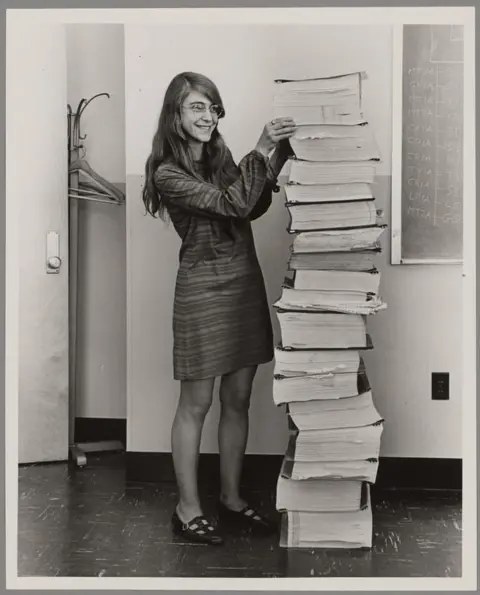
Margaret Hamilton is the computer scientist who led the team that wrote the on-board flight software for NASA’s Apollo missions, and her name has become shorthand for reliable, error-tolerant code. Decades after the first Moon landing, engineers, students, and tech writers still return to her story, because it explains how a small group of programmers built software that had to work the first time, with no chance for a patch. In this guide from AI Power Digest, we cover her life, her work on Apollo, the famous alarms during the Apollo 11 landing, the honors she earned, and the lessons her career offers to anyone building technology today, including artificial intelligence.
A quick note on sources: this article is a biography and a technical explainer based on public reporting from NASA, major news outlets, and published histories. Where accounts differ, we say so, and we avoid claims that cannot be verified.
Who Is Margaret Hamilton? A Quick Profile
Before diving into the details, it helps to have the short version. Margaret Hamilton was born Margaret Heafield on August 17, 1936, in Paoli, Indiana. She became a mathematician-turned-programmer, directed the Software Engineering Division at the MIT Instrumentation Laboratory (today known as Draper Laboratory), and led the development of the on-board flight software for the Apollo Guidance Computer. Later she founded two software companies, Higher Order Software in 1976 and Hamilton Technologies in 1986, both in Cambridge, Massachusetts. In 2016, President Barack Obama awarded her the Presidential Medal of Freedom.
Those facts alone make Margaret Hamilton one of the most important figures in computing history. But the more interesting story is how she approached the work, and why her methods still matter.
Early Life and Education
Margaret Hamilton was born in Indiana and earned a bachelor’s degree in mathematics in 1958. According to the Association for Women in Science, she planned to attend graduate school but took a programming job at MIT instead. That decision looks small on paper, yet it placed her inside one of the most active computing environments in the world at exactly the moment when software was about to become essential to space travel.
Early Career: Weather, Air Defense, and a New Craft
At MIT, Margaret Hamilton worked on software projects before Apollo, including early weather-prediction programming, and she later contributed to the SAGE air-defense effort, according to published biographies. These jobs taught her habits that she carried into the space program: respect for real-time systems, obsession with detecting errors early, and a belief that programmers must plan for the unexpected. At the time, there was no established discipline called software engineering, no standard degree path, and very little prestige attached to writing code.
How Margaret Hamilton Joined the Apollo Program
NASA issued its first major Apollo contract in August 1961 to MIT, which was tasked with developing the guidance and navigation system for the spacecraft, as described in a NASA History Division profile written when she received her medal. Margaret Hamilton became part of that effort in the mid-1960s. Sources differ slightly on the exact year she joined, with some citing 1963 and others pointing to 1965 as the point when she took responsibility for the flight software, so it is safest to say she joined in the middle of the decade.
The MIT Instrumentation Laboratory and the Guidance Computer
The Apollo Guidance Computer was a remarkable machine for its time, but it was tiny by modern standards. Its memory was small, and its programs were physically woven into hardware known as core rope memory, which made late changes extremely difficult. That limitation shaped every decision. Margaret Hamilton and her colleagues had to fit a real-time flight system into a very small space, and they had to be sure it would behave correctly under stress.
Her role grew quickly. She became the lead developer for the on-board flight software and eventually directed the Software Engineering Division. In that position she oversaw the team writing and testing the software for both the Command Module and the Lunar Module.
Software Engineering Before the Term Existed
One of the most repeated facts about Margaret Hamilton is that she coined the term “software engineering.” NASA’s own history profile credits her with leading the team that developed the building blocks of software engineering, a phrase she coined herself. She has explained that she wanted the work to be taken seriously in the same way as hardware engineering, with rules, testing, documentation, and accountability. In an environment where software was often treated as an afterthought, that framing was a quiet act of leadership.
Margaret Hamilton and the Apollo 11 Moon Landing
The moment that made her story famous happened on July 20, 1969, a few minutes before Neil Armstrong and Buzz Aldrin touched down on the lunar surface. As the Lunar Module descended, the guidance computer began displaying program alarms coded 1201 and 1202. To many viewers, that sounds like a crash. In reality, it was the software doing exactly what Margaret Hamilton’s team had designed it to do.
What the 1201 and 1202 Alarms Actually Meant
The alarms meant that the computer was overloaded and could not finish every task in its cycle. According to published explanations, including a Space.com biography that draws on Hamilton’s own 2009 recollections, the overload happened during the landing, and the software recovered in the tense minutes before touchdown. The NASA History Division account adds that the alarm announced that the computer was shedding less important work, such as the rendezvous radar, so it could focus on steering the descent engine and giving the crew landing information.
The trigger was a hardware configuration issue involving the rendezvous radar, which was feeding the computer data it did not need during the landing. The key point is that the software did not freeze. Instead, it dropped lower-priority jobs and kept the essential ones running.
Why the Software Recovered
The design philosophy behind this behavior was priority scheduling. Margaret Hamilton’s team built the flight software so that tasks were ranked by importance. When the system was overloaded, it would restart and re-establish the most critical jobs first, rather than handle everything in the order it arrived. The crew still saw alarms, which was the point: the system was designed to report its trouble clearly while continuing to fly.
Technical histories also credit earlier work by Halcombe Laning on the asynchronous executive that Hamilton’s team used and extended. That detail matters, because it shows that Apollo’s software was the product of many minds. Margaret Hamilton led the effort, but she built on others’ ideas and relied on a large team.
The Role of Mission Control
The software could keep running, but a human decision was still required. On the ground, guidance controllers had to decide whether the alarms meant an abort. Reports name Steve Bales as the guidance officer on duty, supported by Jack Garman, who recognized the alarm codes. They judged that as long as the alarms were not continuous, the landing could proceed, and they told the crew to continue. Flight controllers had confidence in the system because they had studied how it behaved, and that trust was part of the design.
CBS News, in a profile of Hamilton, quoted President Obama’s later remark that the astronauts had little time but were fortunate to have Margaret Hamilton. For a software leader, it is hard to imagine a stronger endorsement.
The Apollo 8 Story: When Margaret Hamilton’s Warning Came True
Another famous anecdote shows how Margaret Hamilton thought about errors. In the version she has told publicly, and which CBS News also touches on in its profile, her young daughter was playing with a simulator and accidentally selected a pre-launch program while the simulated craft was already in flight. That action crashed the simulation. Margaret Hamilton wanted to add protection against that kind of mistake, but NASA managers reasoned that a thoroughly trained astronaut would never make such an error.
During the Apollo 8 mission, an astronaut made essentially that mistake in flight, and her team worked to fix the resulting navigation problem. The lesson is simple and still powerful: if a human can do something wrong, assume that eventually someone will. Good design plans for real behavior, not ideal behavior.
Why Margaret Hamilton Coined “Software Engineering”
The phrase “software engineering” might feel ordinary today, but in the 1960s it was a statement. Hamilton wanted a name that conveyed discipline. She believed software deserved the same seriousness as bridges or aircraft, because the consequences of failure could be just as severe.
Rigor as a Safety Feature
NASA’s profile emphasizes her systems approach and her insistence on rigorous testing. That emphasis shows up again and again in descriptions of her work: simulations, reviews, error detection, and recovery planning were not extras; they were the core. Her stance can be summarized in a single idea. Do not assume the code will be used correctly, and do not assume the world will behave as planned.
A Remarkable Safety Record
NASA’s history account states that no software bugs were found on any crewed Apollo mission, and that the Apollo guidance software was adapted for use in Skylab, the Space Shuttle, and the first digital fly-by-wire systems in aircraft. That claim is attributed to NASA, and it should be read carefully: it does not mean the software was flawless in every sense, since the Apollo 11 alarms show the system under stress. It means the architecture was resilient enough to keep the missions on track.
Margaret Hamilton’s Design Principles That Still Matter
You do not have to build spacecraft to benefit from Margaret Hamilton’s ideas. Many of her principles appear in modern reliability engineering, cybersecurity, and AI safety discussions.
Principle 1: Expect Failure and Plan for It
Margaret Hamilton designed Apollo software to detect errors and recover from them. In modern terms, that is graceful degradation. When something breaks, the system should lose non-essential features first, not everything at once.
Principle 2: Prioritize What Matters Most
The priority scheduler is a classic example. In any complex system, tasks compete for limited resources. A well-designed system decides in advance which tasks are critical. This applies to everything from phone operating systems to cloud services.
Principle 3: Make Errors Visible
The alarms on the Apollo display were annoying, but they gave the crew and flight controllers vital information. Margaret Hamilton’s approach treated warnings as part of the interface, not as an embarrassment. Today’s engineers call this observability.
Principle 4: Design for Human Error
Her daughter’s simulator accident and the Apollo 8 incident show why interface design must account for mistakes. Good software protects users from catastrophic actions, especially when stress is high.
Principle 5: Test Relentlessly
Simulation was a major part of Apollo preparation. Margaret Hamilton pushed her team to test unlikely scenarios because the cost of a missed scenario was too high.
Beyond Apollo: Higher Order Software and Hamilton Technologies
After leaving MIT in the 1970s, Margaret Hamilton moved into the private sector. In 1976 she co-founded Higher Order Software, and in 1986 she founded Hamilton Technologies, Inc., where she served as CEO. Both companies were based in Cambridge, Massachusetts.
The Universal Systems Language
Her later work focused on a methodology she called “development before the fact,” which aimed to prevent software errors through the way systems are specified and designed, rather than finding them later through testing alone. This work led to the Universal Systems Language, which she described in an article titled “Universal Systems Language: Lessons Learned from Apollo,” published in IEEE Computer in 2008. Researchers continue to debate how widely the approach has been adopted, but the underlying goal is familiar to any engineer: prevent defects instead of chasing them.
Writing and Speaking
Margaret Hamilton also wrote about Apollo’s lessons, including a 2018 article in IEEE Software titled “What the Errors Tell Us.” She wrote a 1971 letter to Datamation that corrected misunderstandings about the nature of the 1201 and 1202 alarms. These contributions show that she saw explaining the work as part of the job.
Awards and Honors for Margaret Hamilton
Recognition came late, but it came in a big way.
- 2003: NASA honored her with a special award recognizing the value of her innovations in Apollo software development. NASA’s history profile notes that it included the largest financial award the agency had presented to any individual up to that point.
- 2016: On November 22, President Barack Obama awarded her the Presidential Medal of Freedom, the highest civilian honor in the United States, for her work leading the development of the on-board flight software for NASA’s Apollo Moon missions.
- 2016: The full Apollo 11 guidance computer source code, digitized from printed listings, became widely visible on GitHub. According to MIT as quoted by Space.com, the first full line of the software credits Margaret Hamilton as the Colossus programming leader, dated March 1969.
That final point is a special kind of recognition. Developers around the world can open the code and see her name at the top.
Margaret Hamilton and the Famous Photograph
Most people first encounter Margaret Hamilton through a photograph from 1969. She stands beside a stack of printed listings that is taller than she is, and the pages represent the navigation software her MIT team created for Apollo. The image works because it makes invisible work visible. Software normally lives on screens, so seeing it on paper as a physical tower communicates scale instantly.
Smithsonian reporting has also highlighted this image and her wider contributions in a feature on how she led NASA’s software team to the Moon. Even so, it is worth remembering that the stack represents the output of a group, not a single person. The photograph is a symbol, and symbols simplify.
Separating Fact From Legend
Because her story is so inspiring, it attracts exaggeration. A responsible biography should separate what is well documented from what is popular storytelling.
What Is Well Documented
- Margaret Hamilton led the Software Engineering Division at the MIT Instrumentation Laboratory.
- She led the development of on-board flight software for Apollo.
- She received the 2003 NASA award and the 2016 Presidential Medal of Freedom.
- The software handled the 1201 and 1202 alarms during the Apollo 11 landing by shedding lower-priority work.
What Needs Context
- “She single-handedly saved Apollo 11.” She led a team, built on earlier work such as Laning’s executive, and relied on controllers, astronauts, and many engineers. Her leadership was critical, but the success was collective.
- “The software was perfect.” The alarms show that the system was stressed. Its strength was how it behaved under stress.
- “She was the only woman involved.” Many women contributed to the space program in different roles, though they were often under-recognized. Margaret Hamilton was among the first women on the Apollo software project, according to published profiles, but she was not alone in the larger effort.
A cleaner way to tell the story is this: Margaret Hamilton helped define how to build software for high-stakes systems, and her team’s design choices made a measurable difference on the most famous night in space history.
The Apollo Guidance Computer: Why the Constraints Mattered
To appreciate the software, it helps to understand the machine it ran on. The Apollo Guidance Computer was a landmark of its era, one of the first computers to use integrated circuits in a flight system, yet by today’s standards it was astonishingly limited. Commonly cited specifications describe roughly two thousand words of erasable memory and around thirty-six thousand words of fixed memory, with a clock speed measured in about one megahertz. A modern phone is millions of times more capable, which makes the Apollo achievement all the more striking.
Fixed Memory and the Cost of Changes
Much of the program lived in core rope memory, a form of storage in which wires were physically threaded through or around magnetic cores to represent ones and zeros. Once the rope was manufactured, the software was effectively locked in. Because of that, the team could not simply push an update the night before launch. Every routine had to be designed, reviewed, simulated, and verified well in advance. That environment rewards careful planning and punishes improvisation, and it explains why the team’s reviews and simulations were so thorough.
Real-Time Computing Under Pressure
During a lunar descent, the computer had to read sensors, update the position of the spacecraft, drive the display, handle crew inputs, and manage engine commands, all in repeating cycles that left no slack. If any one job ran long, it could crowd out another. The executive software that scheduled these jobs was therefore the heart of the system, and its behavior under overload was a design question, not an accident. This is why the alarms on landing day are better understood as a sign of the scheduler working than as a sign of failure.
Human and Machine Working Together
The cockpit interface, known as the DSKY, let astronauts enter commands as numeric verbs and nouns and read back codes from the computer. It was not friendly by modern standards, but it reflected a careful division of labor. The machine did the arithmetic and bookkeeping, while the crew and the ground team made judgment calls. When the alarms appeared, they were an example of the computer asking humans to apply judgment, and the humans had been trained to understand what the codes meant.
Timeline of Key Moments
A short timeline can help readers keep the sequence straight. Dates are drawn from the public sources cited in this article, and where sources disagree, the entry is described in general terms.
- 1936: Born in Paoli, Indiana, on August 17.
- 1958: Earns a bachelor’s degree in mathematics and begins working as a programmer at MIT instead of going straight to graduate school.
- 1961: NASA issues the first major Apollo contract, awarded to MIT, for the guidance and navigation system.
- Mid-1960s: Joins the Apollo effort at the MIT Instrumentation Laboratory and takes on a leading role in the flight software.
- 1969: The Apollo 11 landing takes place on July 20, with the 1201 and 1202 alarms occurring during the descent.
- 1971: A letter from the Apollo software director appears in Datamation, clarifying misunderstandings about the alarms.
- 1976: Higher Order Software is founded in Cambridge, Massachusetts.
- 1986: Hamilton Technologies is founded in the same city.
- 2003: NASA presents a special award recognizing the value of the Apollo software innovations.
- 2008: The paper on the Universal Systems Language and lessons from Apollo is published in IEEE Computer.
- 2016: The Presidential Medal of Freedom is awarded on November 22, and the Apollo 11 source code becomes widely visible on GitHub.
- 2018: An article titled “What the Errors Tell Us” appears in IEEE Software.
Why Women in Early Computing Deserve More Attention
The story of the Apollo software sits inside a larger history. In the early decades of computing, programming was often treated as clerical work, and many of the people doing it were women. As the field gained prestige and pay, the demographics shifted, and many of those early contributors were later overlooked. Public interest in Apollo’s software leader has helped bring renewed attention to this broader group, including mathematicians, programmers, and engineers whose names were rarely printed in the newspapers of the time.
It is worth keeping that wider context in mind without turning any one individual into a stand-in for everyone. Historians generally encourage readers to look at the full range of contributors, from the people who wrote code to those who tested hardware, managed schedules, and trained crews. Doing so produces a more accurate picture of how complex projects succeed, and it avoids the trap of crediting a single hero for a collective effort.
How to Learn More From Primary Sources
If this article has made you curious, the best next step is to read the original material. NASA maintains extensive archives of Apollo mission transcripts and technical documents, and the agency’s history pages describe how the guidance software was developed. The digitized source code on GitHub lets curious programmers read the actual routines, including comments that give a feel for the team’s working style. Published interviews, conference talks, and journal articles add the voices of the people involved.
When you read, keep a few habits in mind. Check dates and names against more than one source. Notice when an account is a retelling of an earlier retelling. Treat dramatic claims, such as statements that something “saved the mission single-handedly,” with healthy skepticism. The real story is impressive enough without embellishment, and an accurate account teaches better lessons.
What Margaret Hamilton Teaches Modern AI and Tech Builders
For a blog that covers technology and AI, her legacy is more than a history lesson. It is a design checklist.
Reliability Is a Product Feature
Users rarely praise software for not failing, yet reliability is often the difference between trust and abandonment. Margaret Hamilton’s work shows that reliability must be designed in from the start.
AI Systems Need Graceful Failure Too
Modern AI systems can produce confident but wrong outputs, and they can be pushed outside the conditions they were tested on. The Apollo mindset suggests several questions for AI builders: What happens when inputs are strange? Which functions are critical, and which can be dropped under load? How does the system tell a human that it is uncertain? Margaret Hamilton would likely recognize these questions immediately, because they are the same ones she asked about spacecraft.
Culture Matters as Much as Code
NASA managers initially dismissed her worry about the simulator mistake, and reality later vindicated her. Teams should create space for engineers to raise uncomfortable scenarios. A culture that listens to the person asking “what if?” is safer than one that assumes training will prevent every error.
Frequently Asked Questions About Margaret Hamilton
1. Who is Margaret Hamilton?
Margaret Hamilton is an American computer scientist and systems engineer who directed the Software Engineering Division at the MIT Instrumentation Laboratory and led the development of on-board flight software for NASA’s Apollo program. She later founded two software companies and received the Presidential Medal of Freedom in 2016.
2. What did Margaret Hamilton do for Apollo 11?
She led the team that created the flight software running on the Apollo Guidance Computer. During the landing, that software handled the 1201 and 1202 alarms by dropping lower-priority tasks and continuing to run the essential ones.
3. Did Margaret Hamilton coin the term “software engineering”?
NASA’s history profile says she coined the term herself while leading the team that developed the building blocks of the discipline. She wanted software to be treated with the same seriousness as other engineering fields.
4. When was Margaret Hamilton born, and is she still alive?
She was born on August 17, 1936, in Paoli, Indiana, according to published biographies. As of this writing in October 2026, she would be 90 years old, but readers who need current information should check recent, reliable news sources.
5. What is the famous photo of Margaret Hamilton?
It is a 1969 photograph of her standing next to a tall stack of printed Apollo navigation software listings from her MIT team. It is widely used to illustrate the scale of the work.
6. What awards has Margaret Hamilton received?
Notable honors include a special NASA award in 2003 and the Presidential Medal of Freedom in 2016, presented by President Barack Obama.
7. Can I read the Apollo 11 code that Margaret Hamilton’s team wrote?
Yes. The Apollo 11 guidance computer source code has been digitized and published on GitHub. The header of the code lists her as the programming leader for Colossus, dated March 1969.
8. Was Margaret Hamilton the only person responsible for the Apollo software?
No. She was the leader of a large team, and the software also built on earlier ideas from other engineers. Her leadership and design philosophy were central, but the achievement belongs to the whole group.
9. Where can I read reliable information about the Apollo software?
Start with NASA’s history pages and mission archives, then look at established news and museum sources, such as the Smithsonian and major broadcasters. For technical detail, the digitized Apollo 11 source code and the published journal articles by the Apollo software team are the most direct sources. Always cross-check dramatic claims against more than one reputable source.
Conclusion: Why Margaret Hamilton Still Matters
The story of Margaret Hamilton is not only about a Moon landing. It is about a way of thinking: assume things can go wrong, build systems that notice problems, and make sure the most important work continues even when conditions are far from ideal. Those ideas helped Apollo 11 land, and they remain just as relevant for cloud platforms, medical devices, financial systems, and AI products.
If you enjoy stories that connect technology history to today’s tools, keep exploring AI Power Digest for more plain-English guides. And the next time you see the famous photograph of Margaret Hamilton beside her tower of code, remember that the image stands for something larger than one person: a team, a discipline, and a standard for software that people can trust with their lives.
Disclaimer: This article is for general informational and educational purposes only. Historical accounts of the Apollo program vary in detail, and some figures and dates are reported differently by different sources. For authoritative information, consult primary sources such as NASA and the institutions named above.